The band model is an energy diagram used to describe the conductivity of conductors, insulators, and semiconductors. The model consists of two energy bands (the valence band and the conduction band) and the band gap. The valence electrons – which serve as charge carriers – are located in the valence band; in the ground state, the conduction band is not occupied by electrons. Between the two energy bands lies the band gap, whose width, among other things, influences conductivity.
The Energy Bands
Looking at a single atom, according to the Bohr atomic model there are sharply separated energy levels that can be occupied by electrons. When several atoms are located next to one another, they interact with each other and the discrete energy levels fan out. In a silicon crystal there are approximately 5×10²² atoms per cubic centimetre, so that the individual energy levels are no longer distinguishable from one another and instead form broad energy ranges.
The width of the energy bands depends on how strongly the electrons are bound to the atom. The valence electrons at the highest energy level interact strongly with those of neighbouring atoms and can be detached from the atom relatively easily; with a very large number of atoms, a single electron can no longer be assigned to a specific atom. As a result, the energy bands of the individual atoms merge into a continuous band, the valence band.
The Band Model in Conductors
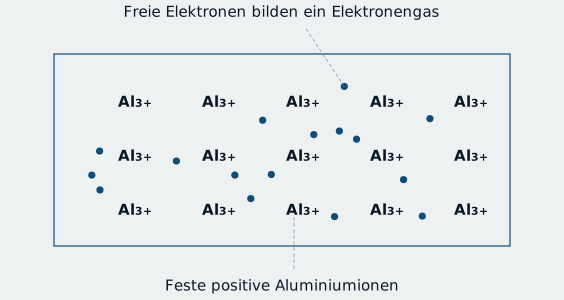
In conductors, the valence band is either not completely filled with electrons, or the filled valence band overlaps with the empty conduction band. As a rule, both conditions apply simultaneously, so electrons can move either within the partially filled valence band or within the two overlapping bands. In conductors, there is no band gap between the valence band and the conduction band.
The Band Model in Insulators
In insulators, the valence band is completely filled with electrons due to the bonds between atoms. The electrons cannot move because they are "locked in" between the atoms. To achieve conductivity, electrons would have to move from the fully occupied valence band into the conduction band. This is prevented by the band gap that lies between the valence band and the conduction band.
This gap can only be overcome with a very large amount of energy (if at all) – according to the laws of quantum physics, no electron is allowed to reside within the band gap itself.
The Band Model in Semiconductors
Semiconductors also have this band gap, but compared to insulators it is so small that, even at room temperature, electrons pass from the valence band into the conduction band. These electrons can then move freely and act as charge carriers. In addition, each electron leaves behind a hole in the valence band, which can be filled by other electrons in the valence band. This results in migrating holes in the valence band, which can be regarded as positive charge carriers.
Electron–hole pairs always occur together, meaning there are just as many negative as positive charges, and the semiconductor crystal as a whole remains neutral. A pure, undoped semiconductor is referred to as an intrinsic semiconductor; there are approximately 1010 free electrons and holes per cubic centimetre (at room temperature).
Since electrons always adopt the energetically most favourable state, they fall back into the valence band without any energy supply and recombine with holes. At a given temperature, an equilibrium is established between electrons being raised into the conduction band and electrons falling back. As temperature increases, the number of electrons able to cross the band gap increases as well. Thus, the conductivity of semiconductors increases with rising temperature.
Since the width of the band gap corresponds to a specific energy and therefore a specific wavelength, attempts are made to specifically alter the band gap in order to obtain certain colours in light-emitting diodes. This can be achieved, among other methods, by combining different materials. Gallium arsenide (GaAs) has a band gap of 1.4 electron volts (eV, at room temperature) and therefore emits red light.
The intrinsic conductivity of silicon is of little interest for the functioning of devices, since it depends very strongly on the amount of energy supplied. It therefore also changes with operating temperature, and a conductivity comparable to that of metals is only reached at very high temperatures (several hundred degrees Celsius). In order to specifically influence the conductivity of semiconductors, foreign atoms can be incorporated into the regular silicon lattice, thereby adjusting the concentration of charge carriers – electrons and holes. This process is called doping.