Cleanroom Design and Utilities

Sections in this chapter

1. The Cleanroom as Part of the Fab

The visible cleanroom is only one part of a semiconductor fab. To maintain stable manufacturing conditions, extensive technical areas are located above and below the actual production floor.

A modern fab can be simplified into several vertical levels. Above the cleanroom are air-handling equipment, filters and, in some fabs, a fan deck or technical interstitial level. The process tools are located in the cleanroom itself. Directly below it is often the subfab, which contains equipment-specific utility systems. A further utility or basement level can carry central utility lines, electrical distribution, wastewater systems and exhaust systems. The exact arrangement differs from fab to fab.

Cross-section of a semiconductor cleanroom fab
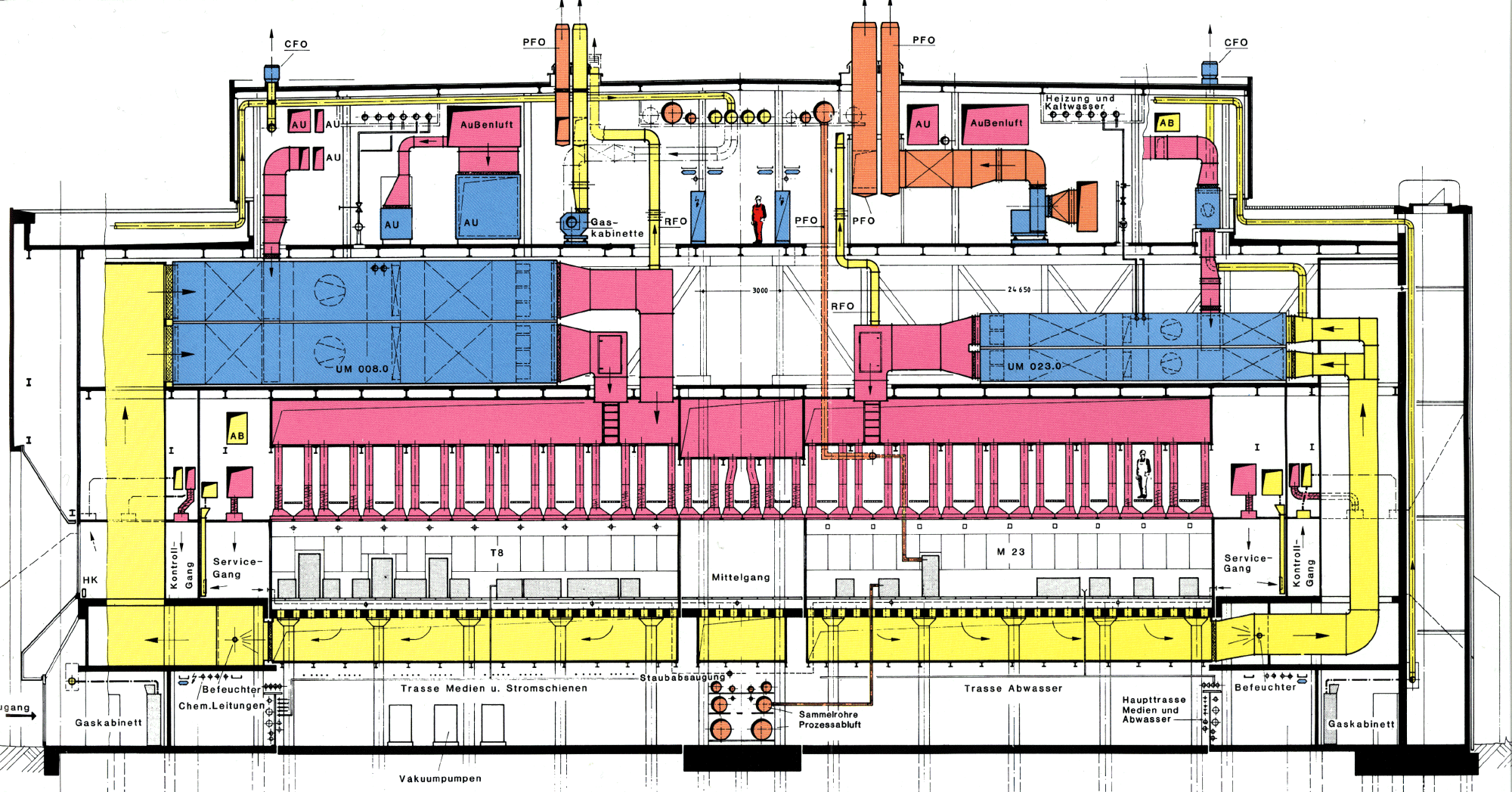
Cross-section of a semiconductor cleanroom fab with air handling, production floor and technical utility level
The actual cleanroom is located on the middle level of the building. Air handling and filtration are above it, while utilities, vacuum pumps, wastewater and process exhaust systems are located below. Source: unknown.

The cross-section illustrates this principle particularly well. The actual production area is in the middle. Above it, large air ducts, outside-air supply, heating and cooling equipment, and filtration and recirculation systems are shown. Below the cleanroom are, among other things, vacuum pumps, chemical lines, power distribution, wastewater routes and collection ducts for process exhaust.

2. Air Handling Above the Cleanroom

A cleanroom requires very large quantities of conditioned air. The entire room volume is not continuously replaced with fresh outside air. A substantial fraction of the air is recirculated because completely heating, cooling, dehumidifying or humidifying, and filtering large volumes of outside air would require enormous amounts of energy.

Additional outside air enters the building through make-up air systems. It is filtered and conditioned to the temperature and humidity required for production. The make-up air replaces, among other things, air removed from the building by process exhaust systems and helps maintain the required cleanroom pressure.

After flowing through the cleanroom, recirculated air is returned, filtered again and supplied back to the production area. This creates a continuous air loop. Compared with an all-outside-air system, recirculation substantially reduces energy demand while maintaining the required air cleanliness.

Continue reading

The remaining sections of this chapter are part of our one-time access. Unlock all knowledge chapters and every PDF download.

1,99 € one time · no subscription

Unlock all content

Already purchased? Restore access