From Fairchild to TSMC: The History of Semiconductor Companies
October 15, 2026
From Bell Laboratories and Texas Instruments through Fairchild, Intel, and AMD to the memory manufacturers of Japan and South Korea: the history of semiconductor companies is also the history of new business models. TSMC, Arm, ASML, and NVIDIA show how research, design, fabrication, and equipment manufacturing developed into a global industry.
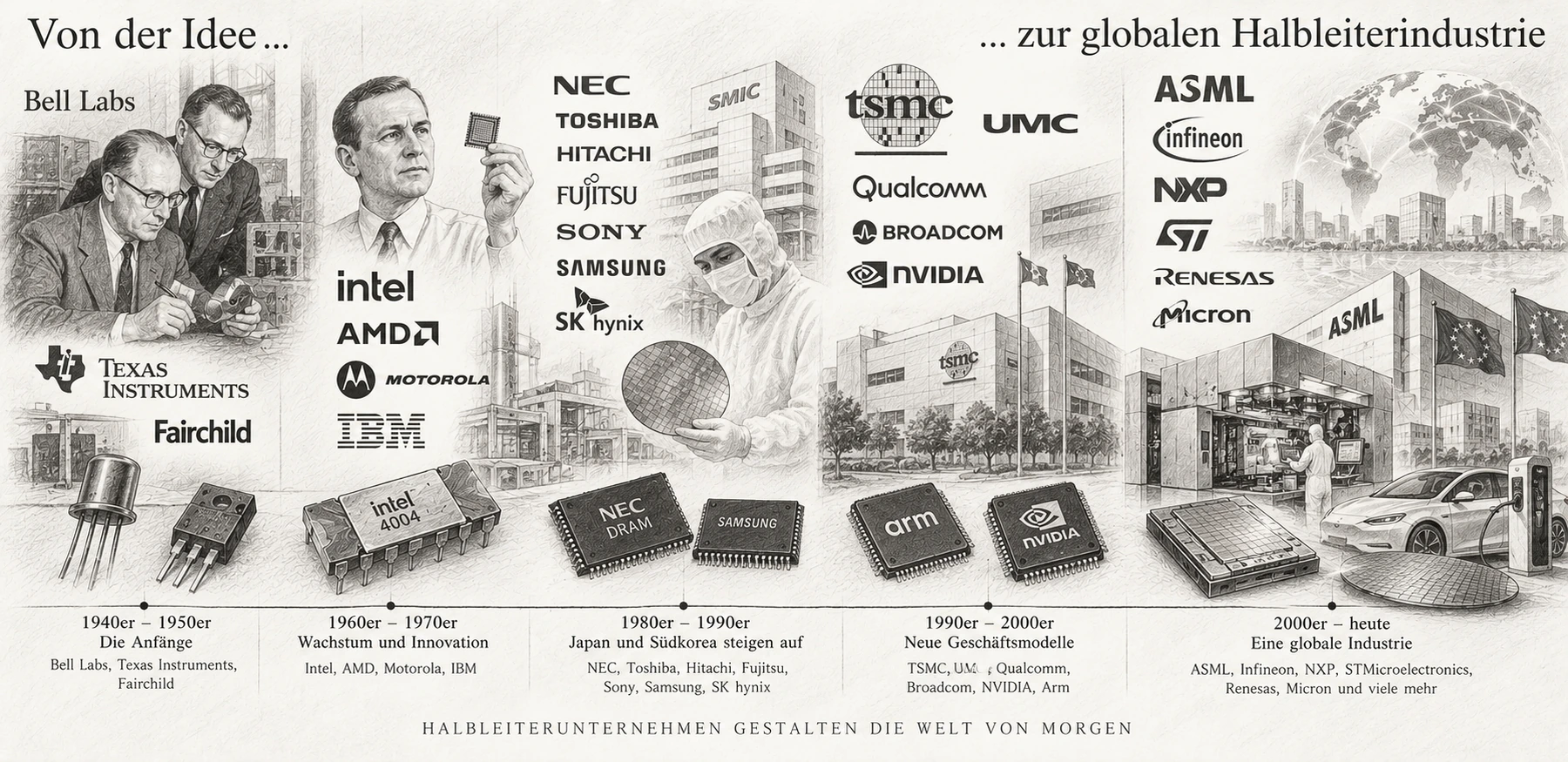
Image: ChatGPT
In 1947, researchers at Bell Laboratories in New Jersey demonstrated the first working transistor. Just a few decades later, companies in the United States, Europe, and Asia were producing billions of transistors on a single silicon wafer. But what kinds of companies gave rise to this industry? Were they major electrical engineering groups, small start-ups, or specialized research institutes? The answer changed with each generation of technology.
In the beginning, many companies had to research, manufacture, and sell their own transistors. Later, specialized suppliers of wafers, chemicals, and manufacturing equipment emerged. Eventually, the design and manufacture of integrated circuits became separate activities: while companies such as NVIDIA and Qualcomm design their own chips, foundries such as TSMC can take over the demanding task of wafer fabrication. The history of semiconductor companies is therefore more than a sequence of famous corporate names. It shows how the industry reorganized itself technologically, economically, and geographically.
The following chronology deliberately follows the companies’ entry into semiconductor technology or their defining turning points. Some of the companies involved were founded decades earlier: Siemens in 1847, Philips in 1891, NEC in 1899, and Toshiba’s predecessors in the nineteenth century. Those earlier founding dates alone do not explain when they became important to semiconductors.
1925–1947: Bell Laboratories establish the scientific foundation
Founded in 1925, Bell Telephone Laboratories were initially not a conventional chip manufacturer, but the research and development laboratories of the American telephone industry. Their work included developing electronic components, transmission techniques, and long-lasting equipment for extensive communications networks. This environment produced important research into semiconductors, solid-state physics, and later digital systems.
John Bardeen and Walter Brattain’s transistor breakthrough in December 1947, followed by William Shockley’s work on the junction transistor, attracted worldwide interest. Bell Labs held scientific expertise and patents, but subsequent mass production was not simply undertaken by one company. Through licensing and technical information sessions in the early 1950s, other firms gained access to key foundations of the technology.
This established a pattern that would shape the semiconductor industry: research at a large laboratory created a new technology, which numerous manufacturers subsequently adopted, improved, and adapted to different markets.
1951–1954: Texas Instruments and the move toward silicon
Texas Instruments had unusual roots. Its predecessor, Geophysical Service, was established in 1930 to carry out geophysical surveys for oil exploration. During the Second World War, the company developed electronic systems for military applications. It became Texas Instruments in 1951 and soon began investing in semiconductor devices.
In 1954, a Texas Instruments team led by Gordon Teal presented early silicon transistors. This was significant because germanium initially dominated transistor technology. Silicon promised advantages at higher temperatures and later proved especially suitable for oxide-based and planar manufacturing processes. In the same year, TI demonstrated the practical value of transistors in a portable radio that reached the market as the Regency TR-1; the transistors used in that radio were still made of germanium.
In 1958, Jack Kilby developed an early integrated circuit at TI. Together with the later planar approach at Fairchild, this became a foundation of the modern chip industry. In the following years, TI established itself in logic components, analog circuits, and devices for industrial electronics, among other areas. Its history illustrates how companies rooted in measurement technology entered semiconductor manufacturing.
The 1950s: European and Japanese electronics groups enter the field
Semiconductor activities also developed early outside the United States. Philips in the Netherlands conducted research and manufactured diodes, transistors, and later integrated circuits. Its semiconductor division grew out of a larger electronics group that was already producing vacuum tubes, radio equipment, and lighting products. Siemens also established semiconductor manufacturing and materials research in Germany. Companies such as Siemens and AEG played important roles in rectifiers, diodes, and power semiconductors.
In Japan, NEC, Toshiba, Hitachi, and Sony built their own semiconductor capabilities, partly through international licenses and partnerships and partly through their own research programs. These companies already served large markets for consumer electronics, telecommunications equipment, and industrial systems. Their chip manufacturing operations therefore often emerged within established corporations.
This distinction matters historically: the firms were not necessarily newly founded when they entered semiconductors. The new industry grew both out of older electrical engineering groups and out of specialized start-ups established later.
1955–1957: Shockley and Fairchild—the origins of Silicon Valley
In 1955–1956, William Shockley established a semiconductor laboratory in California with backing from Arnold Beckman. It attracted talented scientists and engineers working on silicon transistors. Because of serious internal conflicts, eight employees left the company in 1957. Later known as the Traitorous Eight, they founded Fairchild Semiconductor with the support of Sherman Fairchild.
The founders included Robert Noyce, Gordon Moore, Jean Hoerni, and Jay Last. Fairchild became an important manufacturer of silicon transistors and integrated circuits. The planar process was especially decisive: silicon dioxide could remain on the wafer, allowing conductive interconnects to be patterned on its insulating surface. This made complex circuits more robust and their manufacture more reproducible.
Fairchild also became an extraordinary source of new businesses. Numerous other semiconductor companies emerged from the firm and its network over the following decades. The term Fairchildren refers to this family of enterprises. The region south of San Francisco increasingly developed into a center for semiconductor innovation and technological entrepreneurship.
1959–1969: National Semiconductor, Intel, and AMD are founded
National Semiconductor, founded in 1959, became another important American supplier of semiconductor devices, later particularly active in analog electronics. During the 1960s, the market for logic circuits, amplifiers, and memory grew so rapidly that new companies could find opportunities despite high development costs. Increasing integration density also demanded ever more capital and specialized manufacturing techniques.
In 1968, Robert Noyce and Gordon Moore left Fairchild to establish Intel. The name stood for Integrated Electronics. Intel initially focused heavily on semiconductor memory. Its 1103 DRAM appeared in 1970, followed by the 4004 microprocessor in 1971. Later, x86 processors became the company’s best-known business. Intel’s development shows how a memory specialist could become a defining processor manufacturer.
In 1969, Jerry Sanders and other former Fairchild employees founded Advanced Micro Devices (AMD). Initially, AMD made logic devices and other semiconductors. Later, it became a major competitor in the processor market. The parallel rise of Intel and AMD highlights a distinctive feature of that era: engineers and managers carried expertise between young firms, while different business strategies emerged from similar technological foundations.
The 1960s and 1970s: IBM and Motorola build their own chip businesses
Not all major chip developments came from small start-ups. IBM needed semiconductors for mainframe computers and therefore developed its own manufacturing and memory technologies early on. Robert Dennard’s work on dynamic memory and later advances in packaging and process integration demonstrate how strongly computer manufacturers could influence semiconductor research without primarily operating as independent chip suppliers.
Motorola, whose roots reach back to radio technology in the 1920s, developed semiconductor activities in the 1950s. The company later became known for its 6800 and 68000 microprocessors, microcontrollers, and power semiconductors, among other products. These devices were widely used in industrial systems, automobiles, and computers. Some of Motorola’s semiconductor operations later became independent companies: ON Semiconductor, now branded onsemi, was established in 1999, and the semiconductor division was spun off as Freescale in 2004.
IBM and Motorola therefore represent a third path alongside research institutes and start-ups: large systems manufacturers initially developed chips for their own products and could subsequently expand semiconductor technology into a business in its own right.
1967–1980: Semiconductor equipment becomes a separate industry
In the early chip factories, manufacturers had to solve many production problems themselves. But as structures became finer, it grew increasingly uneconomic to develop all machines, metrology techniques, and process steps in-house. Applied Materials was founded in the United States in 1967, and ASM was established in the Netherlands in 1968 by Arthur del Prado. In the following years, additional companies specialized in processing equipment, deposition, etching, and measurement technology.
KLA was founded in 1975, and its subsequent development became closely associated with inspection and process control. Lam Research, established in 1980, became a major supplier of equipment for wafer processing. These companies do not sell conventional microprocessors, but they are just as essential to manufacturing modern chips as the companies that design them.
A new cross-industry model for innovation emerged. An equipment supplier could develop an especially demanding technical solution and then sell it to multiple chip factories. That allowed new process capabilities to spread faster, while chipmakers’ investments became increasingly dependent on networks of specialized suppliers.
The 1970s and 1980s: Japan’s memory manufacturers become global players
During the 1970s, Japanese companies gained importance in the international semiconductor market. NEC, Toshiba, Hitachi, Fujitsu, and Mitsubishi invested in memory chips, logic, and manufacturing quality. International competition became especially intense in DRAM during the 1980s. High volumes, strong yields, and consistently meeting quality requirements became decisive for success.
Japan’s companies were backed by large electronics groups, but semiconductor manufacturing increasingly followed its own economic rules. New memory generations required heavy investment, while falling market prices could threaten profits. Some manufacturers in the United States left the DRAM business or shifted their focus as Japanese firms expanded their positions.
This industrial history is covered in more detail in the separate article on competition among memory manufacturers. For the chronology of companies, the key point is that early American dominance was by no means permanent: new regional centers emerged as manufacturing expertise expanded.
1974–1983: Samsung and South Korea’s semiconductor industry
Samsung Electronics was founded in 1969 and entered the semiconductor sector in 1974 through its involvement with Korea Semiconductor. At that time, South Korea was not yet a leading location for manufacturing complex memory chips. Samsung nevertheless made long-term investments in skilled personnel, equipment, and semiconductor memory development. In 1983, the company reached an important milestone with its own 64-kilobit DRAM.
Other South Korean corporations developed memory operations in parallel. Hyundai Electronics, founded in 1983, later became Hynix and, following investment by the SK Group, SK hynix. Memory manufacturing became an important industrial focus for South Korea. In this industry, a new production line could create enormous market opportunities but also generate substantial losses.
The later success of Samsung and SK hynix therefore did not result from a single invention, but from repeated investments, process improvements, and industrial persistence across several business cycles. The economic center of gravity in semiconductor manufacturing shifted increasingly toward East Asia.
1978–1980: Micron and UMC—two very different new companies
Micron Technology was founded in Boise, Idaho, in 1978. The company began as a small development team and initially worked on memory circuits. In 1981, Micron shipped its first 64-kilobit DRAMs from its new manufacturing operation. In an increasingly concentrated memory market, the company became one of the few American suppliers to remain in the DRAM business over the long term.
In Taiwan, United Microelectronics Corporation (UMC) was established in 1980 as a spin-off from the government-supported Industrial Technology Research Institute. It was an important step toward building a domestic integrated circuit industry. Unlike TSMC, which later began as a dedicated contract manufacturer, UMC initially made its own semiconductor products as well. Only in 1995 did it fully adopt the foundry model.
The two examples show how different the paths into semiconductor manufacturing could be: Micron began as a privately founded memory company, whereas UMC was part of a broader industrial policy strategy. Both, however, helped change the geographic and economic structure of the semiconductor sector.
1984–1987: ASML, Qualcomm, TSMC, and SGS-Thomson
In 1984, Philips and ASM International founded ASM Lithography, later ASML, in the Netherlands. Its purpose was to develop and market wafer steppers. At the time, the future significance of increasingly demanding lithography was far from obvious. Over the following decades, ASML developed into a central specialist in exposure systems, including the later EUV technology.
Qualcomm was established in San Diego in 1985. Its founders, including Irwin Jacobs, worked on digital communications techniques, especially Code Division Multiple Access (CDMA). The company became an important developer of mobile communication technologies, radio modems, and integrated platforms. It represented a business model in which systems expertise, chip design, and intellectual property worked together.
In 1987, Morris Chang founded TSMC in Taiwan. Its decisive innovation was not so much an entirely new transistor structure as a business model: TSMC did not develop competing processor or memory brands of its own, but concentrated on manufacturing integrated circuits for other companies. This pure-play foundry model established the basis for a far-reaching separation of chip design from chip manufacturing.
Also in 1987, the merger of Italy’s SGS Microelettronica and the French Thomson semiconductor operations created SGS-Thomson, which has been called STMicroelectronics since 1998. It brought together European capabilities in microcontrollers, analog and power semiconductors, and other product groups. This helped form another major industrial network alongside American and Asian manufacturers.
1990–1993: Arm and NVIDIA change how chips are designed
In 1990, Advanced RISC Machines, later Arm, was formed in the United Kingdom as a joint venture between Acorn Computers, Apple, and VLSI Technology. Its business model increasingly centered on licensing processor architectures and associated design blocks instead of manufacturing every chip itself. Customers could integrate Arm technology into their own system-on-chip designs. This became particularly important with the development of low-power mobile devices.
In 1993, Jensen Huang, Chris Malachowsky, and Curtis Priem founded NVIDIA. Initially, the company focused on accelerating PC graphics. Graphics processors subsequently evolved into highly parallel computing machines that were also deployed in research, data centers, and artificial intelligence. The company is an example of the success of a supplier centered on design and system platforms without owning a leading-edge chip fabrication plant.
Both companies represent new parts of the value chain: Arm often supplies processor architectures or licensed IP, while NVIDIA develops its own complex processors and the systems built around them. Physical chip manufacturing can, in turn, take place at specialized foundries. The semiconductor industry was no longer organized solely around companies with their own factories.
1991–1997: More fabless companies emerge
As external chip fabrication became increasingly available, more specialized design companies entered the market. Broadcom, founded in 1991, grew primarily through chips for data transmission, networking, and communications. MediaTek was established in Taiwan in 1997 as a spin-off from the UMC environment and later became a major supplier of integrated platforms for mobile devices and other electronics.
Such companies demonstrate that separating development from fabrication opened up far more business areas than just processors. Businesses could concentrate on particularly effective radio, network, or multimedia architectures without first investing billions in their own factories.
1999–2006: Semiconductor divisions become independent companies
In 1999, Siemens spun off its semiconductor business as the independent company Infineon Technologies. It carried on a long German tradition in semiconductors and went on to develop especially in automotive and power electronics. The separation showed that the capital-intensive chip business, with its own development and market cycles, was increasingly distinct from other divisions of large industrial corporations.
Business units were reorganized in Japan and Europe as well. In 2003, Hitachi and Mitsubishi combined major portions of their semiconductor activities in Renesas Technology. In 2010, it merged with NEC Electronics to form today’s Renesas Electronics. Such mergers pooled development costs and product portfolios and responded to growing demands involving manufacturing, software, and international markets.
In 2006, Philips’ semiconductor division became independent under the name NXP Semiconductors. The new company inherited a much older technological tradition, but gained its own corporate structure. Also in 2006, Infineon separated its memory business as Qimonda. These developments illustrate how different the economic conditions for memory chips, power electronics, and specialized circuits had become.
2009: GlobalFoundries illustrates the next stage of the foundry model
Operating a modern fabrication plant for very small logic structures requires multibillion-dollar investments and enormous amounts of specialized equipment. For companies simultaneously designing and manufacturing processors, financing new factories therefore became increasingly challenging. In 2009, AMD separated its manufacturing operations, forming GlobalFoundries with backing from investors.
This was another visible sign of the separation between chip design and production. AMD increasingly focused on developing processors and graphics chips, while GlobalFoundries continued as a contract manufacturer. The foundry later concentrated especially on selected manufacturing technologies and specialty processes rather than constantly pursuing the smallest available logic node.
The episode shows that even long-established integrated semiconductor companies had to reorganize. Owning manufacturing facilities can provide a strategic advantage, but may involve such high costs that a different business model proves more suitable for particular companies in the long term.
The 2010s: Global specialization becomes the norm
During the 2010s, an increasingly specialized industry structure became established. Fabless companies developed chips, processor architectures, and software platforms. Foundries handled wafer fabrication. EDA suppliers such as Synopsys and Cadence provided design tools, while IP companies supplied reusable circuit blocks. Manufacturers of processing equipment, materials, assembly, and test equipment completed the production chain.
This division of labor also allowed smaller developers to access complex semiconductor processes. At the same time, it created mutual dependencies. A new processor required more than good architectural decisions: suitable libraries, an available foundry process, advanced packaging, and sophisticated test procedures were also needed. Supply chains extended across multiple continents.
Alongside producers of the newest processors, companies specializing in analog, sensor, microcontroller, and power semiconductors remained important. They sometimes used older feature sizes but required just as much specialized technological expertise. The economic significance of a semiconductor company therefore cannot be measured solely by its smallest transistor dimensions or by revenue in a single year.
The 2020s: AI, advanced manufacturing, and the limits of concentration
During the 2020s, demand for specialized processors for data centers and AI systems rose sharply. This brought graphics and AI accelerators, fast memory such as HBM, and advanced packaging into particular focus. Companies including NVIDIA, AMD, Samsung, SK hynix, Micron, and TSMC fulfill different roles that interact closely in modern computing systems.
At the same time, production of the most demanding logic chips remains concentrated among a small number of suppliers and locations. In Europe, ASML plays a major role in lithography, while many American, Japanese, and European suppliers provide crucial process equipment, materials, and measurement systems. A chip factory is therefore never an exclusively national technology: even when a wafer is processed in one particular location, its manufacturing methods rely on international expertise.
Governments are increasingly supporting local manufacturing capacity and more resilient supply chains. The economic success of individual projects, however, depends on sustainable long-term demand, skilled workers, and a functioning network of suppliers. The semiconductor industry thus remains caught between global specialization and the desire for regional security of supply.
Why these particular companies became important
Looking back, the decisive turning points were by no means limited to the founding of new companies. Bell Labs shaped the scientific origins of the industry, while Texas Instruments and Fairchild helped establish its early industrial foundations. Intel and AMD represent the development of complex processors. Japanese and Korean electronics groups demonstrated the importance of manufacturing quality and economies of scale in memory. UMC, and TSMC in particular, transformed the economic organization of wafer fabrication.
ASML and other equipment manufacturers demonstrated that furnishing a chip factory could itself become a leading-edge technology sector. Arm, Qualcomm, and NVIDIA showed the importance of design, architecture, and systems expertise even without owning a cutting-edge fab. Infineon, STMicroelectronics, NXP, and Renesas, meanwhile, represent the continuing importance of microcontrollers, analog electronics, and power semiconductors.
The history of semiconductor companies is therefore not a simple ranking of winners and losers. It is the story of a constantly changing division of labor. In the beginning, individual companies could control much of the value chain themselves. Today, a high-performance chip usually results from contributions by many specialized firms, each solving a tightly defined part of the technical challenge. It was precisely this cooperation that transformed a few early transistor manufacturers into a global industry.
Sources and further reading
- Texas Instruments: Company history from GSI to the integrated circuit
- Intel: Founding in 1968 and its roots at Fairchild
- Semiconductor Industry Association: The Fairchild family and waves of semiconductor start-ups
- Samsung Semiconductor: Corporate history since 1974
- UMC: From a Taiwanese IDM to a foundry company
- TSMC: Founded in 1987 and the pure-play foundry model
- ASML: Company history since 1984
- Arm: Founded in 1990 and the licensing business model
- NVIDIA: Development since its founding in 1993
- Qualcomm: Founded in 1985 and the development of mobile communications technology
- STMicroelectronics: Merger of SGS and Thomson in 1987
- Infineon: Separation of Siemens semiconductor operations in 1999
- NXP: First annual report in 2006 and spin-off from Philips
- Renesas: Corporate merger in 2010
- Micron: Founded in 1978 and early DRAM development