The Development of the Microprocessor
September 14, 2026
From the Intel 4004 calculator chip and the x86 accident of the IBM PC to ARM’s triumph in the smartphone era.
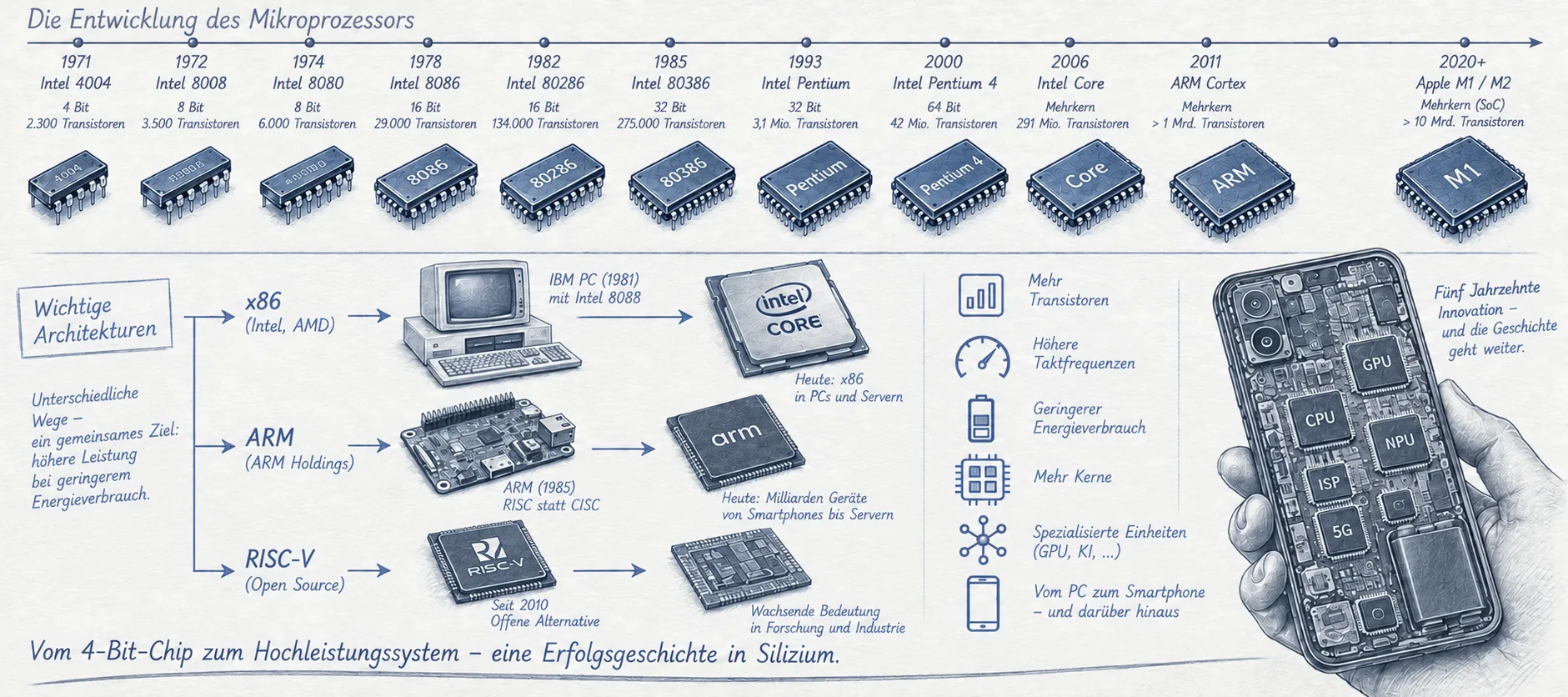
Image: ChatGPT
Just over fifty years separate the first microprocessor from the chip in today's smartphone – and yet a remarkably continuous line can be traced: from a 4-bit arithmetic unit for desktop calculators, through a stroke of chance called the IBM PC, to a British underdog architecture that today runs on more devices than any other CPU architecture in history. The history of the microprocessor is strikingly often a history of compatibility constraints that kept smarter alternatives at bay for decades – until eventually they no longer did.
An Accidental Beginning: Intel 4004
The Intel 4004 was created in 1971 not out of a grand vision for general-purpose computers, but from an order placed by the Japanese company Busicom for a family of custom desktop-calculator chips. Ted Hoff's idea of building a single software-programmable 4-bit chip instead of several hard-wired special-purpose chips drastically reduced the number of chips Busicom required – Federico Faggin led its implementation in silicon, while Stanley Mazor contributed to the instruction-set design. With just 2,300 transistors and a clock frequency of 740 kilohertz, the 4004 was trivially weak by today's standards, but the principle had been established: a complete, programmable processor on a single piece of silicon instead of being distributed across dozens of components.
Calling the 4004 the first microprocessor does not mean that nobody had integrated CPU functions onto chips before it. Four-Phase Systems had built the AL-1 in 1969 as part of a processor architecture using multiple devices, and the MP944 chip set for an aircraft computer represented another early approach. What distinguished the 4004 was the availability of the essential functions of a freely programmable central processing unit on a single commercially offered chip. ROM, RAM, and input/output functions were still provided by separate components in Intel's MCS-4 family.
The development was a team effort. Marcian “Ted” Hoff proposed the architecture, Stanley Mazor contributed to its refinement, and Federico Faggin led the physical design using Intel's silicon-gate MOS technology. Masatoshi Shima, representing Busicom, also played a major role in the logic and practical implementation. In 1971, Intel obtained the right to market the 4004 beyond Busicom's exclusive calculator application. That decision helped turn a custom development contract into a product available to other system designers.
The Leap to 8 Bits: 8008 and 8080
Its direct successor, the 8008 (1972), had originally been intended for a terminal manufacturer called Datapoint, which ultimately decided against using a microprocessor out of concern that it would be too slow for the required performance and instead preferred discrete TTL logic. Intel then simply marketed the already-developed chip itself as a standalone product. The real breakthrough came in 1974 with the substantially redesigned 8080: faster, equipped with a larger instruction set and easier to integrate into practical systems. It became the computing core of the Altair 8800, the kit computer produced by MITS that triggered the home-computer movement in 1975 – and, incidentally, gave two young programmers named Bill Gates and Paul Allen the opportunity to write a BASIC interpreter for it and turn that project into a company called Microsoft.
The 8008 was not merely a straightforward technical successor to the 4004. It originated in a requirement from Computer Terminal Corporation, later known as Datapoint, for a programmable terminal processor. Texas Instruments also worked on a competing single-chip design for this application. When the original customer decided not to adopt the resulting processor, Intel could market the 8008 independently. Its demanding system requirements still showed how far an early CPU chip was from a complete computer.
Introduced in 1974, the 8080 combined substantially improved performance with more practical supporting circuitry and a 16-bit address space for up to 64 KiB of memory. The Altair 8800 sparked a wave of computer kits in 1975, but an expanding ecosystem was just as important: expansion boards, memory, terminals, and programming languages gradually made complete microcomputer systems practical. Gary Kildall's CP/M operating system subsequently allowed applications to run across a variety of 8080- and Z80-based computers. Even at this early stage, software compatibility was becoming a commercial advantage.
1975–1977: The affordable 6502 and Zilog's Z80 bring computers home
While Intel was building its 8080 family, competing designs emerged that greatly expanded the young market. Engineer Chuck Peddle and a team of former Motorola employees developed the MOS Technology 6502, introduced in 1975 at the strikingly low price of $25. This made it practical for small manufacturers and individual enthusiasts to build projects that would have been too expensive with rival processors.
The 6502 powered the Apple II and Commodore PET, while related versions later appeared in the Commodore 64 and game consoles. At Zilog, former Intel engineers including Federico Faggin pursued another processor family. The Z80, introduced in 1976, was largely software-compatible with the 8080 and added instructions and simplified system integration. It became popular in CP/M computers and the TRS-80.
These 8-bit families were not all mutually compatible. Nevertheless, low prices, available programming languages, and a growing software market turned hobby projects into a substantial computer industry. Success depended not just on raw processor capability but on the combination of affordability, practical system design, and accessible software.
The Birth of x86 – and a Consequential Accident
In 1978, Intel introduced the 8086, the first true 16-bit processor in its own product line, and with it the x86 instruction set that continues to live on in every Intel and AMD CPU today. The truly consequential moment, however, did not arrive until 1981: IBM was looking for a readily available, low-risk processor for its first Personal Computer and chose the cost-reduced 8-bit-bus version, the 8088 – partly because the 8-bit external bus supported inexpensive, readily available system components and IBM needed a dependable solution quickly. This otherwise unspectacular procurement decision cemented x86 as the dominant PC architecture for the following four decades, because an enormous industry of compatible clones – Compaq, Dell and many others – and equally compatible software developed around the openly documented IBM PC, creating an ecosystem that nobody could afford to ignore.
Internally, the 8088 was closely related to the 8086, but it used an 8-bit external data bus. For the IBM PC, this made it easier to use inexpensive and readily available peripheral chips and elements of established 8-bit system technology. IBM was operating under considerable time pressure and wanted a design based on commercially available components. The security of long-term supply was relevant, but it was not the only reason for the processor choice.
IBM published extensive technical information about its PC, enabling others to develop compatible expansion cards and software. Companies such as Compaq built compatible machines, while Microsoft could license MS-DOS to other manufacturers. The processor's success was thus part of a growing PC ecosystem, not simply a victory of a particular chip. Intel's 80286 (1982) and particularly the 80386 (1985) added protection features, larger address spaces, and, in the latter case, a full 32-bit architecture. Despite far-reaching internal changes, backward compatibility remained a central design objective.
1979–1985: The Motorola 68000 and the era of graphical computers
Microprocessor evolution was never limited to Intel's product family. Motorola introduced the 68000 in 1979. Its programmer-visible model included 32-bit registers and a comparatively generous address space, while the external data bus was initially 16 bits wide. This combination supported powerful systems without immediately requiring the full hardware expense of a completely 32-bit-wide design.
The 68000 and its successors helped define an era of workstations and personal computers. It powered the original Apple Macintosh in 1984, the Atari ST family, and early Commodore Amiga computers. Larger address spaces and greater computational capability made graphical user interfaces, more sophisticated applications, and more demanding operating systems practical. Yet the market also demonstrated that technical characteristics alone were not enough to guarantee long-term dominance, as the economics of IBM PC compatibility shifted the balance.
The 68000 is historically significant because it showed what a high-performance personal computer outside the x86 ecosystem could look like. Beyond personal computing, the Motorola architecture also remained common for many years in controllers, printers, and other embedded systems.
The RISC Revolution – and How x86 Survived Anyway
During the 1980s, an academic movement centered around David Patterson and John Hennessy at UC Berkeley, as well as John Cocke at IBM, fundamentally challenged the prevailing philosophy of complex instruction sets: Why waste silicon and clock cycles on rarely used, complex machine instructions when a reduced, uniformly sized load-store instruction set could be processed far more efficiently in a pipeline? This RISC philosophy (Reduced Instruction Set Computer) gave rise in the following years to architectures such as MIPS, SPARC and PowerPC, which at times achieved noticeably better performance per transistor in workstations and servers than CISC-based x86. Intel responded to this threat not by changing architectures, but with a compromise: beginning with the Pentium Pro (1995), many x86 instructions were decoded into simpler internal micro-operations for efficient parallel execution – while externally preserving full x86 compatibility with the enormous existing software base. This hybrid approach was sufficient to allow x86 to hold its ground in the desktop and server markets against technically often more elegant RISC competitors.
RISC was not invented by a single university team. During the 1970s, John Cocke and colleagues at IBM studied the performance advantages of using a carefully restricted instruction set. At the University of California, Berkeley, David Patterson and Carlo Séquin developed RISC research processors; John Hennessy's Stanford group pursued a related direction. The objective was not merely to make every instruction “simple”, but to make common operations predictable and efficient to execute in pipelines.
MIPS, SPARC, and other RISC families became successful particularly in workstations, network equipment, and servers. They did not comprehensively replace x86, however, because users and software suppliers had invested heavily in the PC-compatible ecosystem. Modern x86 processors decode many instructions into internal micro-operations executed by parallel units. The familiar contrast between RISC and CISC therefore captures only part of processor design: caches, branch prediction, memory systems, and energy efficiency are just as consequential.
1985–1995: Caches, pipelines, and superscalar execution
As transistor counts increased, CPUs had to do more than simply process wider numbers. Their internal operation became much more sophisticated. Instead of executing each instruction as a wholly separate step, later architectures overlapped stages of work. With pipelining, for example, one instruction may be decoded while an earlier one is still being executed.
Higher clock rates also made access to external memory a severe bottleneck. Integrated caches store frequently needed data and instructions close to the execution units. Branch prediction tries to anticipate which instructions will be needed next. Superscalar processors can begin more than one suitable instruction per clock cycle, while out-of-order execution allows independent operations to proceed while others are waiting for data.
These methods developed over decades in mainframes, minicomputers, and research systems; they increasingly appeared in microprocessors during the 1980s and 1990s. Performance gains therefore came not just from smaller transistors and faster clocks, but from increasingly sophisticated microarchitectures. Even processors sharing the same instruction set can differ substantially in these internal details.
ARM – from British Underdog to Global Standard
One RISC architecture nevertheless did conquer the world, just not where anyone would have expected in 1985. The small British company Acorn Computers developed its own radically simple RISC CPU, the Acorn RISC Machine – ARM for short – out of sheer necessity because available external processors did not adequately meet its performance and cost objectives. An unexpected side effect was exceptionally low power consumption. In 1990, the processor development operation was spun off into the independent company ARM Ltd, partly financed by Apple, which needed an energy-efficient processor for its Newton handheld. The decisive factor was not so much the technology itself as the business model: ARM does not manufacture a single CPU itself, but licenses its instruction-set architecture and ready-made core designs to other companies – Qualcomm, Apple, Samsung, MediaTek and practically every smartphone chip manufacturer – which use them to build their own customized systems on a chip. When the mobile-phone and smartphone revolution took off during the 2000s and 2010s, ARM's power-saving philosophy matched the decisive requirement exactly: practically every smartphone in the world is still based on ARM cores today. ARM has since also entered markets in which x86 was once unchallenged: in 2020, Apple replaced x86 CPUs with its own M-series processors in practically all Mac models, while cloud providers such as Amazon with Graviton and specialists such as Ampere offer ARM-based server processors as more energy-efficient alternatives to conventional x86 servers.
The first ARM developments at Acorn were strongly shaped by Sophie Wilson and Steve Furber. A functioning ARM1 prototype was built in 1985, and the Acorn Archimedes became an early commercial computer using the architecture in 1987. Its relatively modest transistor count made the design economical and energy-efficient. Acorn, Apple, and VLSI Technology were involved in the creation of the independent Arm company in 1990. Arm subsequently developed its business around licensing architectures and processor cores rather than owning a large semiconductor fabrication operation.
For mobile devices, the combination of sufficient computing performance and low power demand became increasingly valuable. Licensing also enabled manufacturers to build different systems-on-chip that included radio communication, graphics, image processing, and later AI acceleration. A processor architecture should not be confused with one particular processor design: an Arm-compatible core developed by Apple can have a very different microarchitecture and performance profile from another Arm-compatible CPU. The advantage is that diverse implementations can nevertheless support a largely shared software platform.
2003: AMD takes x86 to 64 bits without abandoning its software base
One of the most consequential architectural transitions came in the early 2000s. With the Opteron, launched in April 2003, AMD introduced its AMD64 extension into the server market, followed by the Athlon 64 for desktop systems. Rather than abandoning the existing processor architecture, the new processors could continue running much of the installed 32-bit x86 software while also supporting 64-bit applications. They enabled larger virtual address spaces and additional registers.
Compatibility made the transition easier for operating systems, software vendors, and customers. Intel subsequently adopted a compatible 64-bit extension to its own x86 processors. AMD64 illustrates a recurring pattern: a technical transition is more readily accepted when it does not invalidate the existing software base, even when processor implementations change substantially underneath.
Modern CPUs: from Processor Core to Heterogeneous System
The chip inside a modern smartphone or laptop has long since ceased to consist of a single processor core. Instead, it is a complete system on a chip (SoC): CPU cores, graphics processor, image signal processor, modem and, increasingly, a dedicated AI processing unit (NPU) for machine learning directly on the device all share the same chip area. Even among the CPU cores themselves, heterogeneity has replaced uniformity: ARM's big.LITTLE principle, combining energy-efficient cores with high-performance cores on the same chip, has now found its way back into the x86 world through Intel's Alder Lake generation (2021) with its P-cores and E-cores. The classic general-purpose single processor core has therefore become just one of several specialized building blocks on the same piece of silicon.
Modern CPU performance cannot be described by clock rate or transistor count alone. The number and organization of cores, shared caches, memory bandwidth, and thermal limits all influence practical performance. In smartphones, specialized functional units further improve energy efficiency because image processing, video, radio functions, and neural networks can often run more efficiently on dedicated hardware than on a general-purpose CPU.
Physical integration is changing as well. Some high-performance processors distribute functions across multiple dies, commonly called chiplets, connected within one package. Other systems still integrate most functions on a single monolithic system-on-chip. Both approaches involve trade-offs in yield, energy consumption, communication between blocks, and cost. Microprocessor development has therefore become increasingly tied to system architecture and advanced packaging technologies.
2004–2005: Clock speeds hit practical limits, and multiple cores take over
During the 1990s, manufacturers often increased both transistor count and clock frequency significantly. As power density and complexity rose, however, heat and energy consumption became major constraints. New manufacturing technologies continued to permit smaller features, but power consumption no longer scaled down as conveniently as before. Rather than continuing to accelerate a single core, manufacturers increasingly had to use available chip area differently.
Multi-core processors were an important response. IBM, Sun, and others had already explored multi-core and multithreading architectures; Intel's dual-core desktop products reached the broader market in 2005. Two cores can execute different tasks simultaneously or share work that has been written to run in parallel. A single non-parallel task, however, does not automatically become twice as fast.
Operating systems and application software once again became crucial. Task scheduling, synchronization, and efficient sharing of memory increasingly determined the real performance gained from additional CPU cores. The history of the microprocessor is therefore also a history of parallel programming.
2010 to the present: RISC-V and the idea of an open instruction set
Alongside x86 and Arm, a further architectural path emerged: RISC-V. Researchers at the University of California, Berkeley began designing a relatively clean, extensible instruction set for education and research in 2010. The specification was made publicly available, and the RISC-V Foundation was formed in 2015. One distinguishing feature is that the standardized instruction set can be openly implemented and used.
RISC-V does not mean that every chip based on it must be open source or can be manufactured without cost. An instruction set defines what software may expect a processor to do. The implementation, chip design, and related tools can be open or proprietary. The resulting freedom encourages research, education, and custom processor development, but it does not remove the substantial expense of advanced semiconductor manufacturing.
This brings an old question back into focus: How much value comes from a common, reliable software platform, and how much freedom do designers need to create new hardware? Embedded devices, specialized accelerators, and experimental CPUs make clear that the history of microprocessor architectures is far from finished.
A Common Thread of Compatibility and Disruption
From the 4004 to the modern SoC, one recurring pattern can be seen: once an instruction-set architecture has become established, it often survives far beyond the period of its technical superiority because the software and tool ecosystem that grows around it becomes the real competitive advantage – x86 benefited from this for forty years. Major changes in market share have often followed the emergence of new device categories with different requirements for energy consumption, cost, and integration – as happened to x86 during the mobile revolution, when ARM's philosophy of energy efficiency from the outset made it the de facto standard of the connected world.
Historical development is more complex than a simple replacement of x86 by Arm. Both families continue to evolve and remain important in different markets, while other instruction sets survive in controllers and specialized processors. An architecture succeeds not solely because of an elegant instruction encoding, but also because of development tools, operating systems, industrial partners, and the experience of software engineers.
The general-purpose programmable processor provided the starting point. Increasingly, progress has involved specializing computational functions without abandoning the flexibility of programmable systems. The path from a calculator contract therefore leads not only to PCs and smartphones, but also to connected industrial machines, large data centers, and application-specific accelerators.
Sources and further reading
- Computer History Museum: Who Invented the Microprocessor?
- Computer History Museum: Microprocessor Integrates CPU Function onto a Single Chip (1971)
- Computer History Museum: 1975 – MOS 6502
- Computer History Museum: 1976 – Zilog Z80 and CP/M
- Computer History Museum: 1979 – Motorola 68000
- IBM: The IBM Personal Computer
- IBM: The Origins of RISC
- Arm: The Official History of Arm (2026)
- AMD: Introduction of the AMD Opteron (2003)
- Intel: The Dual-Core Era Begins (2005)
- RISC-V International: About RISC-V and Its History