How Taiwan Became a Global Chip Powerhouse
October 12, 2026
From technology transfer with RCA to the founding of TSMC and the rise of the foundry model: how Taiwan changed the rules of the semiconductor industry.
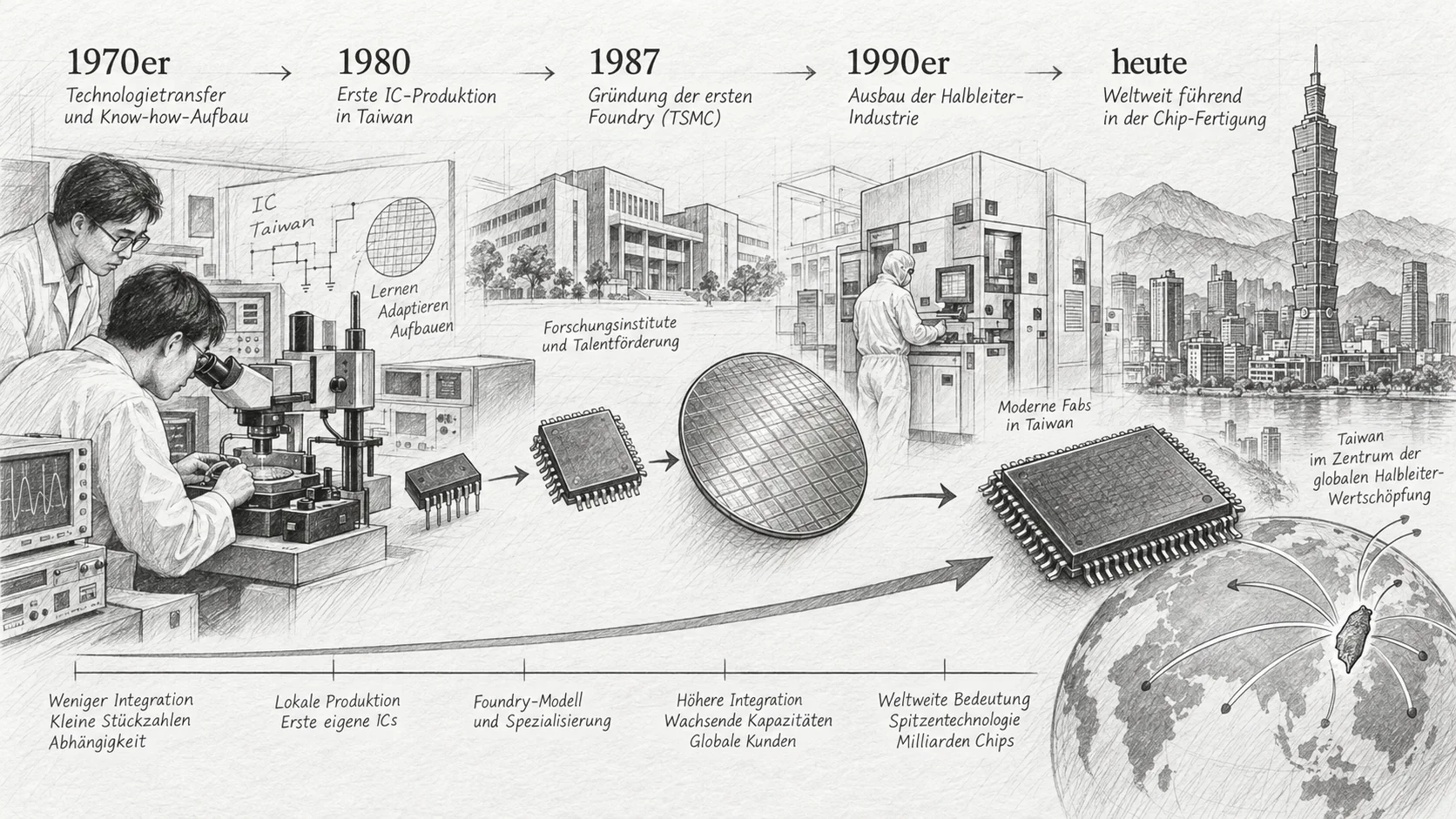
Image: ChatGPT
The most advanced processors are often designed by companies in the United States, the lithography systems needed to manufacture them come from Europe, and production equipment and materials are supplied by manufacturers around the world. Yet when it comes to the most powerful logic chips, it is almost impossible to avoid Taiwan. How did an island with virtually no significant integrated-circuit production in the early 1970s become one of the semiconductor industry's most important manufacturing centers?
The answer does not begin with one ingenious chip. Taiwan's success grew out of an unusual combination of government industrial policy, targeted technology transfer, experienced engineers, and a business decision that initially seemed to defy the industry's conventions: manufacturing chips for other companies without designing chips of its own.
A Country Looks for a New Industry
By the 1960s and early 1970s, Taiwan had already become an important location for assembling and exporting electronic products. Many higher-value components and the technologies required to make them, however, still came from abroad. In the long term, simply manufacturing labor-intensive consumer goods was not a secure foundation for further industrial growth. Rising wages and international competition increased the pressure to develop technological capabilities at home.
Integrated circuits offered an attractive opportunity, but also considerable risk. A chip factory required substantial up-front investment, specialized equipment, expertise in chemical processes and, above all, staff capable of operating a stable production line. Taiwan could not gain that experience merely by purchasing a few machines. The government therefore chose a gradual approach involving a publicly supported research institute.
1974: A Breakfast Meeting and the Start of Technology Transfer
According to the founding history documented by Taiwan's Industrial Technology Research Institute (ITRI), several government and technology representatives met for breakfast in 1974. Among them was Wen-Yuan Pan, a semiconductor specialist working for RCA in the United States. Their conversation gave rise to an idea: Taiwan should not merely assemble electronic devices but systematically learn how to manufacture integrated circuits.
In 1976, ITRI signed an agreement with the American company RCA to transfer IC technology. Nineteen selected specialists were sent to the United States, where they learned different aspects of circuit design, fabrication processes, testing and equipment operation. Technical documentation alone was not enough. The engineers had to learn how to respond to deviations, control contamination and make manufacturing processes reproducible in everyday production.
In 1977, a demonstration fab using 3-inch wafers began operating in Taiwan. According to ITRI, it achieved a yield of approximately 70 percent working chips after six months; the institute cites around 50 percent for the original RCA line. Such figures are directly comparable only for similar products and processes. Their historical significance lies above all in the new team's ability not merely to reproduce the transferred process but to operate and improve it reliably. By 1978, chips for electronic watches were being manufactured in Taiwan.
1980: A Research Project Becomes an Industry
The next step was to transfer knowledge from the laboratory into commercial companies. United Microelectronics Corporation (UMC) was spun off from ITRI in 1980. It took on employees and manufacturing technology designed for 4-inch wafers. UMC was among the first companies in Hsinchu Science Park, which also opened in 1980.
Hsinchu was more than an inexpensive industrial estate. Research institutes, universities, young semiconductor companies and, later, numerous suppliers were clustered closely together. Knowledge could therefore circulate more quickly between research, chip design, manufacturing and the workforce. Rather than building isolated factories, Taiwan developed an ecosystem in which new companies could draw on existing specialists and experience.
At this stage, Taiwanese manufacturers were far from leading the world technologically. But they learned how to use manufacturing capacity economically, bring products into volume production and retain process expertise within Taiwan. That laid the groundwork for a much more radical next step.
Morris Chang Turns the Business Model Upside Down
Morris Chang had spent much of his career at the American semiconductor manufacturer Texas Instruments. When he arrived in Taiwan in 1985 and took charge of ITRI, he knew the economic limitations of the established industry from personal experience. At that time, major semiconductor companies generally designed their own chips and manufactured them in their own plants. Such vertically integrated companies are now known as integrated device manufacturers (IDMs).
The model had a problem: owning a fab was extraordinarily expensive, but without one, young chip design teams had few opportunities to manufacture their products in large volumes. Other manufacturers could sometimes offer spare capacity, yet they were often potential competitors as well. Entrusting a design to a rival meant becoming dependent on that rival's manufacturing operation at a sensitive stage.
Chang's answer was dedicated contract manufacturing, the pure-play foundry. Such a company would develop processes and manufacture wafers but, as a rule, would not sell its own branded chips. Customers would design the circuits and the foundry would manufacture them. The manufacturer would become a partner rather than a competitor. Separating design from fabrication was by no means an obvious choice at first: it meant concentrating entirely on one capital-intensive activity before a substantial market of fabless chip designers even existed.
1987: The Founding of TSMC
Taiwan Semiconductor Manufacturing Company (TSMC) was founded in 1987. Its foundations included ITRI's research and facilities; according to the institute, 98 specialists moved to the new company. Funding came from Taiwanese public sources, local investors and the Dutch electronics group Philips, which also contributed technological expertise.
Unlike a traditional chip company, TSMC was not trying to gain market share with its own microprocessor, memory or logic device. It had to demonstrate that it could reliably manufacture other companies' designs: with transparent design rules, stable processes, high yields and sufficient capacity. Protecting the confidentiality of different customers' designs was another central commitment.
TSMC did not invent the idea of outsourcing chip manufacturing. Its innovation was to make that service the exclusive, long-term business model of a major semiconductor manufacturer. In doing so, it turned the chip fab from an internal department into an industry in its own right.
Why Contract Manufacturing Set Off a Chain Reaction
This division of labor changed who could establish a semiconductor company. A young design team still needed considerable expertise, design software, verification methods and money for photomasks. But it no longer had to build a fab first. That created much better conditions for fabless companies specializing in chip architecture and circuit design.
With every additional customer, a foundry gained production experience. It could improve yields, process control and testability while maintaining more consistent fab utilization through orders from multiple companies. Customers, in turn, benefited because the cost of expensive new manufacturing equipment could be spread across many different chips. This mutually reinforcing relationship made the model more attractive with each successive technology generation.
The result was not an exclusively Taiwanese success story. American and other international chip designers, EDA software developers, IP suppliers and equipment makers played essential roles. Meanwhile, Taiwan became home to companies such as MediaTek and numerous specialists in masks, assembly and testing. UMC, too, later shifted more strongly toward dedicated contract manufacturing. The industry did not break into isolated pieces; it became an internationally connected system built on specialization.
From Low-Cost Manufacturer to the Technological Frontier
A common misconception is that Taiwan succeeded primarily because of low wages. In a modern wafer fab, however, multibillion-dollar equipment, yield, throughput, downtime and the number of usable chips per wafer account for a large share of production costs. A company that stabilizes a process faster and loses fewer wafers can be more competitive than a rival with lower labor costs.
TSMC therefore invested not only in new factories but also in the ability to run sophisticated process technologies repeatedly at high production volumes. Demand from numerous customers helped finance those investments. Over time, this created a self-reinforcing advantage: leading designers sought dependable manufacturing, major orders supported further investment, and that investment made the foundry still more attractive to new customers.
By the 2010s at the latest, the goal was no longer simply to reproduce technologies developed elsewhere. TSMC had developed its own advanced processes and brought a 7 nm FinFET generation into volume production in 2018, followed by a 5 nm generation in 2020 and its first 3 nm FinFET generation at the end of 2022. These names denote technology nodes, not uniformly measurable transistor dimensions. Competition increasingly centered on actual performance, energy efficiency, transistor density and, above all, how reliably a process could deliver chips at scale.
Smartphones, AI and the New Importance of Packaging
The smartphone boom accelerated this development. Companies could design new processor architectures and have them made by TSMC without owning manufacturing equipment themselves. The foundry, in turn, received large and recurring orders for high-performance, energy-efficient chips. Later, when demand rose for artificial-intelligence accelerators, the same industrial division of labor became important for even larger and more complex devices.
A small feature size alone is no longer sufficient. High-performance processors must be connected to very large amounts of memory at high data rates. TSMC therefore developed additional integration technologies such as CoWoS (Chip on Wafer on Substrate). The company had already demonstrated corresponding test vehicles and qualified the technology for production in 2012. Multiple chips can be closely coupled within one package through a high-density interconnect substrate. Combined with high-bandwidth memory (HBM), advanced packaging later became an essential element of powerful AI accelerators.
The foundry's role thus changed as well. Instead of supplying only individual dies from wafer fabrication, it increasingly provided technologies for integrating entire chip systems. Taiwan's success now depends as much on mastering interfaces, material systems and production chains as it does on manufacturing the smallest transistors.
Why the World Depends on Taiwan—and Taiwan on the World
The concentration of advanced semiconductor manufacturing in Taiwan makes supply chains vulnerable. Natural disasters, water and energy supplies, and political tensions surrounding the island can therefore have economic consequences worldwide. This has given rise to the idea of a silicon shield: the chip industry's importance might create additional international incentives to preserve peace and stability. It is, however, a political proposition, not a guarantee against conflict.
At the same time, it would be wrong to regard TSMC as a completely independent manufacturing power. The most advanced processes require, for example, lithography systems from ASML, other equipment from the United States, Japan and Europe, international materials suppliers and chip design software. Many important chip designs are likewise developed outside Taiwan. Global dependence is therefore mutual, although not symmetrical.
TSMC is also building capacity outside the island, including in Japan, the United States and Germany. Its first factory in Kumamoto, Japan, began volume production toward the end of 2024; according to the company's 2025 annual report, additional sites were being built or expanded. Yet Taiwan's particularly dense concentration of process development, suppliers and experienced specialists cannot quickly be replicated simply by constructing new buildings.
The Real Invention Was the Division of Labor
Taiwan's rise as a global semiconductor powerhouse was neither an accident nor the achievement of one individual. Without ITRI's publicly supported development of expertise, there would have been too few skilled workers and too little process knowledge. Without UMC and Hsinchu Science Park, an industrial network would hardly have emerged so quickly. Yet without Morris Chang's foundry model, that network would probably have played a different role in the global economy.
The decisive break with tradition was to offer the most expensive stage of chip production as an independent service to many competing designers. A place that initially had to acquire fabrication expertise from abroad became a central partner for chip companies around the world. Taiwan's most important achievement was therefore not a single record-breaking transistor, but a system that made it possible to manufacture new ideas as chips in the first place—and in enormous volumes.