Mishaps in Semiconductor History: When Tiny Errors Have Major Consequences
October 13, 2026
Five faulty entries in a Pentium division table, microscopic tin whiskers bridging contacts, an unintentionally triggered thyristor inside a CMOS chip, and individual radiation particles flipping memory bits: semiconductor history also includes astonishing failures. What caused them—and how did they change the reliability of modern electronics?
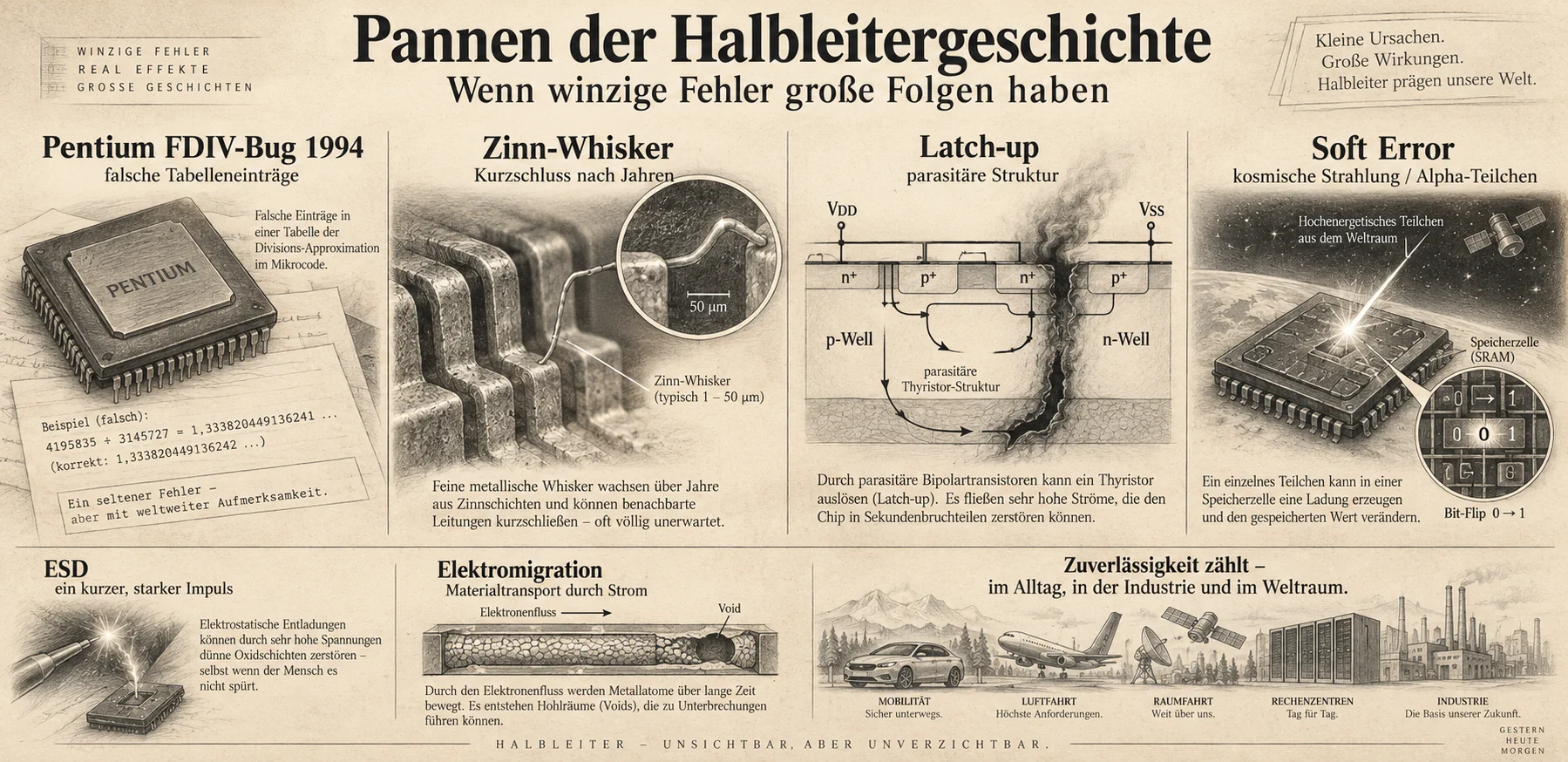
Image: ChatGPT
In the autumn of 1994, American mathematics professor Thomas Nicely ran calculations on a new Pentium PC. While studying number sequences, he noticed an odd result: some divisions did not deliver the accuracy the processor was supposed to guarantee. The computer did not crash. The calculation completed, and its result looked plausible—yet it was wrong. In an industry capable of manufacturing billions of transistors with extraordinary precision, a handful of incorrect entries in an internal computation table triggered an expensive processor replacement program.
But spectacular electronic failures do not always begin with design mistakes. Sometimes an almost invisible filament of tin grows between two contacts. Sometimes a CMOS chip accidentally switches on a parasitic thyristor and heats up dangerously fast. And sometimes a particle from the natural radiation environment changes a stored zero into a one. Such incidents shaped semiconductor history by forcing engineers to rethink devices, materials, testing methods, and even whole system architectures.
One distinction is essential: a design bug, a manufacturing defect, an aging mechanism, and a random soft error are different things. Some faults exist when a chip leaves the factory, others develop after years, and others change only an electrical state without permanently damaging the semiconductor. What they share is the potential for consequences at the system level that far exceed their microscopic causes.
The early decades: A functioning chip was not necessarily a reliable chip
As transistors increasingly replaced vacuum tubes during the 1950s, they promised lower power consumption, smaller dimensions, and greater reliability. Yet semiconductor components had vulnerabilities of their own. Impure crystals, uncontrolled surfaces, poor contacts, and insufficiently protected pn junctions could change electrical characteristics or cause complete failures. A laboratory prototype could function well without being reproducibly manufacturable in large volumes.
Planar processing, oxide passivation, and automation solved many early problems. Meanwhile, thinner oxides, finer metal lines, and more densely packed memory cells introduced new sensitivities. Reliability became a distinct engineering discipline: companies tested not merely whether circuits worked, but how they behaved under heat, humidity, electrical stress, and thousands of hours of operation.
A principle that remains true today was already emerging: mechanical, chemical, electrical, and logical problems can interact inside an integrated circuit. Determining the actual failure mechanism is at least as important as observing that the device stopped working.
The 1960s: When metal interconnects slowly disappear
Electromigration is a particularly insidious aging mechanism. When high current density flows through a thin metal line, electrons transfer momentum to metal atoms. Over time the atoms can move. Vacancies and eventually a void form in one location, while material accumulates elsewhere. An interconnect may become open-circuit, or accumulation may contribute to a short under unfavorable conditions.
The physical phenomenon was known earlier, but it grew critical for increasingly narrow IC metallization. James R. Black investigated such failure mechanisms in the 1960s and published foundational work in 1969 relating current density, temperature, and the lifetime of thin metal films. These studies helped establish accelerated lifetime testing and reliability models that remain essential in interconnect design.
A vulnerable chip might initially pass every functional test. The connection may open only after many operating hours. Electromigration is therefore not one famous recall but an enduring class of field failures, relevant from early ICs to today's high-performance processors.
The 1970s: An invisible current path inside CMOS
With the rise of CMOS came a failure mechanism that at first seems paradoxical. CMOS uses complementary n- and p-channel MOSFETs, designed to carry current along selected paths. But arranging n-wells, p-type substrates, and doped source/drain regions also creates parasitic bipolar transistors within the silicon.
These unintended npn and pnp structures may interact as a four-layer thyristor. Normally they remain inactive. A voltage transient, input overshoot, injected charge, or other disturbance can trigger the structure and create a low-resistance path from the power rail to ground: latch-up.
The conduction does not necessarily stop when the original trigger disappears. The two parasitic transistors sustain each other. As long as the supply provides enough holding current, the path may remain active, producing excessive supply current, localized overheating, or permanent destruction.
CMOS designers responded with well and substrate contacts, guard rings, controlled substrate resistances, larger critical spacings, and standardized latch-up testing. Other isolation and substrate technologies helped later. Latch-up thus became a fundamental design hazard rather than a single named incident.
1978–1979: A memory error originates in the package
DRAM densities grew rapidly during the 1970s, while the electric charge representing each bit became smaller. Engineers sometimes observed incorrect bits even though affected cells worked normally after being rewritten. Unlike a broken transistor or interconnect, the error changed the stored state, not necessarily the physical device.
In 1979, Timothy C. May and Murray H. Woods of Intel described a surprising cause: alpha particles emitted by traces of naturally radioactive elements in packaging materials. Uranium and thorium may exist in tiny concentrations in otherwise ordinary materials. Their radioactive decay can send alpha particles into silicon, generating many electron-hole pairs along a track. If enough charge reaches a sensitive storage node, the logical bit changes state.
Such incidents are called soft errors because they do not initially leave permanent damage. The cell can be rewritten, but the incorrect bit may corrupt a calculation, file system, or control function. Manufacturers began to select low-radioactivity packaging materials and introduce additional protection for sensitive memories.
The striking lesson was that an almost perfect silicon structure could still fail because of a material outside the die itself.
1979: Cosmic radiation also reaches computers
A second source of soft errors lies overhead rather than inside a package. High-energy particles from space strike Earth's atmosphere and produce showers of secondary particles. Some—especially neutrons—reach ground level. Their interactions with atomic nuclei inside a semiconductor can produce charged reaction products that disturb sensitive nodes.
In an influential 1979 publication, James F. Ziegler and W. A. Lanford demonstrated that cosmic radiation could be a real reliability factor for semiconductor memories. They examined interactions in silicon and the influence of shielding, altitude, and solar activity. As memory cells grew denser and stored less charge, the natural radiation environment became increasingly relevant.
It is important not to confuse the two mechanisms: the alpha particles studied by May and Woods can originate in radioactive contaminants in packaging, while cosmic-ray-related errors studied by Ziegler and Lanford typically involve particles produced in atmospheric cascades. Both may flip bits, but their sources, energy spectra, and mitigation strategies differ.
How one flipped bit can cause a major system failure
One changed memory bit sounds harmless. Its importance depends on what it represents. A flipped bit in unused memory might go unnoticed; a corrupted instruction, pointer, or safety-critical parameter may have serious consequences.
Spacecraft face additional radiation sources and higher particle energies. Besides single-event upsets (SEUs), which change stored bits, single-event transients (SETs) can create brief erroneous signals, and other events can disrupt larger functional blocks. Radiation may even trigger single-event latch-up, potentially destructive and fundamentally different from a correctable soft error.
Countermeasures include error-detection and correction—especially error-correcting code (ECC) memory—periodic memory scrubbing, redundancy, protection circuits, and radiation qualification. Basic ECC schemes may correct single-bit errors but not arbitrary multi-bit patterns. Protection must be matched to the application, device, and expected environment.
The reverse conclusion matters, too: an unexplained computer crash is not automatically evidence of cosmic radiation. Without measurements, dedicated investigation, or statistical evidence, the cause often cannot be established confidently.
Tin whiskers: Metal filaments that seem to grow from nowhere
Whereas a soft error changes an electrical state, tin whiskers can cause actual electrical short circuits. Under certain conditions, very thin metallic single-crystal filaments emerge from tin surfaces. Often only a few micrometers across, they can grow several millimeters long. If they touch a neighboring lead or conductor, an unintended conducting bridge forms.
Tin whiskers are not silicon crystals, bonding wires, or deliberately fabricated structures. They emerge from metallic surfaces such as tin-plated component leads, contacts, or relays. Mechanical stress within the tin coating is an important factor, though the precise growth behavior depends on material, plating, substrate, and environment. A component may pass delivery inspection and develop a fault much later.
The phenomenon has been known since the mid-twentieth century but has proved difficult to eliminate completely. Tin-lead alloys can markedly suppress whisker formation, whereas pure tin surfaces can be problematic. The later shift toward lead-free materials renewed attention to the issue, but did not create it.
From a microscopic filament to a satellite failure
NASA maintains a collection of tin-whisker failure reports involving industrial, military, and space equipment. For several commercial communications satellites, suspected short circuits from tin whiskers on plated relay contacts have been associated with failures in control processors.
One example is Galaxy VII. After its primary control processor failed in June 1998, its redundant processor failed in November 2000. NASA lists the satellite among incidents associated with a possible tin-whisker mechanism. Diagnosing the precise cause in inaccessible orbiting equipment, however, is necessarily less conclusive than analyzing a recovered circuit board in a laboratory.
Galaxy IV, whose failure in May 1998 disrupted many pager services in the United States, is also frequently mentioned in this context. Caution is essential here: NASA explicitly identifies the initial processor failure as not caused by whiskers, and other possible explanations—including space weather—have been discussed. Attributing the entire event definitively to tin whiskers would therefore be misleading.
The general hazard is well established. A whisker may permanently bridge contacts in a low-current circuit or produce a brief arc where more energy is available. Long-lived satellites and equipment that cannot readily be serviced therefore require strict material specifications. NASA restricts pure tin finishes on many critical electronic parts.
An electronics failure after roughly 20 years
A further NASA-documented incident in the electric-power industry illustrates how slowly damage may appear. An electronic assembly installed around 1983 failed around 2002 after a tin whisker connected two neighboring pins of an integrated circuit. The bridged gap was approximately 0.75 to 1.0 mm.
Investigation revealed many additional whiskers. Whether they had grown continuously or spent long periods dormant could not be determined. For reliability engineering, the lesson was unambiguous: passing factory tests—and even operating without trouble for years—does not prove that every material-related aging mechanism has been eliminated.
That distinguishes a whisker failure from the Pentium FDIV bug. On affected Pentium chips, particular computations were wrong from the beginning. A whisker-related failure may arise only after decades of otherwise correct operation.
1994: A mathematician exposes the Pentium
Returning to perhaps the best-known individual processor bug in PC history: in 1994 Thomas Nicely noticed inconsistencies while investigating number sequences on a Pentium computer. Systematic comparisons with other machines traced the discrepancy to certain floating-point divisions. Other researchers confirmed the problem, and news spread through early online forums and the technical press.
Its cause was neither contaminated silicon, dust on a wafer, nor a physically damaged arithmetic unit. The Pentium used an accelerated division algorithm that selected values from an internal table for successive steps. In the affected processors, five relevant table entries were absent or incorrect. Under particular operand combinations, the processor could therefore compute an erroneous result.
The flaw became known as the FDIV bug, after the x86 floating-point division instruction. Most divisions were unaffected; many users would never have noticed. But applications requiring mathematical correctness could silently receive wrong answers, without any warning from the processor.
The public reaction proved stronger than Intel had initially expected. The company first assessed the bug largely in terms of statistical frequency. Users, however, saw a question of trust: a processor should calculate correctly regardless of who happened to encounter a rare input. Under pressure, Intel changed its replacement policy in December 1994 and offered affected owners replacement processors on request.
$475 million for five erroneous entries
Intel's 1994 annual report recorded a $475 million charge primarily covering replacement processors, materials, and inventory associated with the FDIV issue. A tiny part of an arithmetic design had become an event with an extraordinary financial cost.
The case transformed the public discussion of processor errata. It demonstrated that sophisticated fabrication can reproduce a logical design error perfectly across millions of chips. That is a distinctive danger of design defects: the more efficiently manufacturing runs, the greater the number of flawed products that may be produced before the bug is discovered.
Verification consequently acquired even more importance: test vectors, reference mathematical models, simulation, formal methods, and transparent documentation of processor errata all became essential parts of engineering. No technique, however, absolutely guarantees that every possible combination of internal states and inputs has been tested.
1997: An invalid instruction freezes a computer
Another Pentium flaw in 1997 illustrated a different design risk. The F00F bug involved a particular sequence of machine-code bytes that could leave a processor unable to respond normally. A restart was required to regain use of the system.
Unlike FDIV, this was not a rare numerical discrepancy but an incorrect response to an invalid instruction. Particularly troubling was that unprivileged program code could trigger the condition. A microarchitectural defect thus became a problem for the stability and security of entire operating systems.
Software workarounds and later hardware fixes prevented further exploitation. The incident showed that the boundary between hardware and software is porous: incorrect chip behavior can crash an entire computer, while an operating-system update can mitigate the effect.
2011: A faulty chipset and $733 million
In 2011, another problem affected the PC market. Intel identified a design issue in its 6 Series Express chipset family, code-named Cougar Point. Certain SATA connections to storage drives could become less reliable in service. The processor cores themselves were not at fault; the defect affected the accompanying chipset.
Intel halted shipments of affected versions, revised the silicon design, and began delivering corrected chips in February 2011. Its annual reporting ultimately put the cost of repair and replacement of affected materials and systems at approximately $733 million. Once again, a detail in a complex electronic design had an enormous commercial impact.
From a fab perspective, the lesson resembled the 1994 case. A defect may pass initial production testing and become visible only under certain conditions or after operation over time. Long-term functionality and lifetime assumptions must be tested alongside manufacturing quality.
ESD, damaged oxides, and hidden pre-existing damage
Not every serious electronics failure is attached to a famous date. Electrostatic discharge (ESD) is a daily risk in semiconductor manufacturing. A discharge barely noticeable to a person may create an extremely high electric field at a sensitive input, damaging thin gate oxides, overloading pn junctions, or locally heating metal lines.
Sometimes failure is immediate. Sometimes a structure is only weakened and continues to operate with reduced safety margin. It can be difficult to trace a later field failure conclusively to its original ESD event. Countermeasures include protection circuitry, grounded workstations, conductive packaging, and controlled handling procedures.
Insulators also change during sustained operation. Strong fields can accelerate defect formation in thin dielectrics until insulation fails. In MOSFETs, bias temperature instability (BTI) and related aging mechanisms shift threshold voltages. A device must therefore satisfy its specifications not only today, but over its required operating life despite predictable degradation.
Why even perfect cleanrooms cannot prevent these failures
Cleanrooms reduce particles and chemical contamination, while modern tests identify many manufacturing defects. Yet they cannot remove every risk. The FDIV bug resided in the design and would not be repaired by cleaner processing. A tin whisker may grow years after shipment. A natural radiation particle can cause a soft error. And latch-up results from parasitic structures intrinsic to many CMOS processes.
Manufacturers therefore use multiple, overlapping reliability strategies. Design for Reliability addresses hazards before manufacturing. Process monitoring, burn-in, and stress tests aim to uncover early failures and aging mechanisms. Physical failure analysis locates defects through microscopy, electrical testing, thermal imaging, and cross-sections. At the system level, ECC, watchdogs, redundancy, and fault tolerance compensate for the limits of individual components.
These measures work remarkably well: in most applications, modern electronics are dependable for many years. The famous mishaps do not prove semiconductors are inherently unreliable. Rather, they reveal the effort required to make billions of components operate across diverse environments and service lifetimes.
What these failures share—and how they differ
Placed side by side, the examples belong to four distinct classes:
- Design defects: Pentium FDIV, F00F, and the 2011 chipset issue arose from characteristics of digital or analog design. The chips could be manufactured exactly to specification and still behave incorrectly.
- Structural vulnerabilities: CMOS latch-up comes from parasitic semiconductor structures. Whether it actually occurs depends on layout, protective measures, and triggering conditions.
- Material and aging failures: Electromigration, dielectric degradation, and tin whiskers may develop over extended periods. Devices can initially work perfectly and fail only much later.
- Random radiation effects: Soft errors disturb data or states without necessarily causing permanent device damage. They are managed with suitable fault tolerance rather than complete elimination of every source of radiation.
This classification also helps with troubleshooting. Otherwise, an isolated memory upset might be mistaken for a failed cell, an entirely systematic arithmetic flaw might prompt replacement of a circuit board, or an aging contact problem might be overlooked because the assembly passed a brief functional test.
The real achievement: Learning from failures
Major semiconductor mishaps tell stories not just of failed devices, wrong results, and costly recalls, but also of learning to detect faults in the first place. The Pentium case highlighted logical verification and transparent errata communication. Radiation-induced bit flips accelerated improvements in materials and error protection. Latch-up reshaped layout rules and testing standards. Tin whiskers influenced material specifications for long-lived, safety-critical electronics.
The process will never be complete. Smaller structures, new materials, 3D integration, and more complex packages create new capabilities alongside new failure mechanisms. Even as individual transistors become more dependable, billions of interacting devices make complete systems harder to characterize.
The most lasting lesson may be a practical one: a chip is not reliable simply because it worked once. It is reliable when its developers understand possible failure modes, define safe limits, and prepare for circumstances in which risks cannot be entirely removed. In that sense, the semiconductor industry became more capable not despite its mishaps, but partly because of what they forced engineers to learn.
Sources and further reading
- Rhode Island Computer Museum: Pentium Floating-Point FDIV Bug
- Intel: Historical Annual Reports, insbesondere Geschäftsbericht 1994
- Intel: Intel Identifies Chipset Design Error, Implementing Solution (2011)
- Intel: Annual Report 2011, Note 20 „Chipset Design Issue“
- NASA NEPP: Tin Whisker Failures, dokumentierte Satelliten- und Gerätefälle
- NASA NEPP: Basic Info on Tin Whiskers
- NASA NEPP: Tin Whisker Failure after Approximately 20 Years
- NASA: Pure Tin Plating Prohibition
- T. C. May und M. H. Woods: Alpha-particle-induced soft errors in dynamic memories (1979)
- J. F. Ziegler und W. A. Lanford: Effect of Cosmic Rays on Computer Memories (1979)
- IEEE Technology Navigator: Latch Up
- J. R. Black: Electromigration—A Brief Survey and Some Recent Results (1969)
- NASA: Reliability Handbook for Silicon Monolithic Microcircuits, Volume 2 (1969)