The History of the LED
September 14, 2026
From a forgotten discovery in 1907 through Holonyak’s red LED and the white phosphor LED to the global lighting revolution.
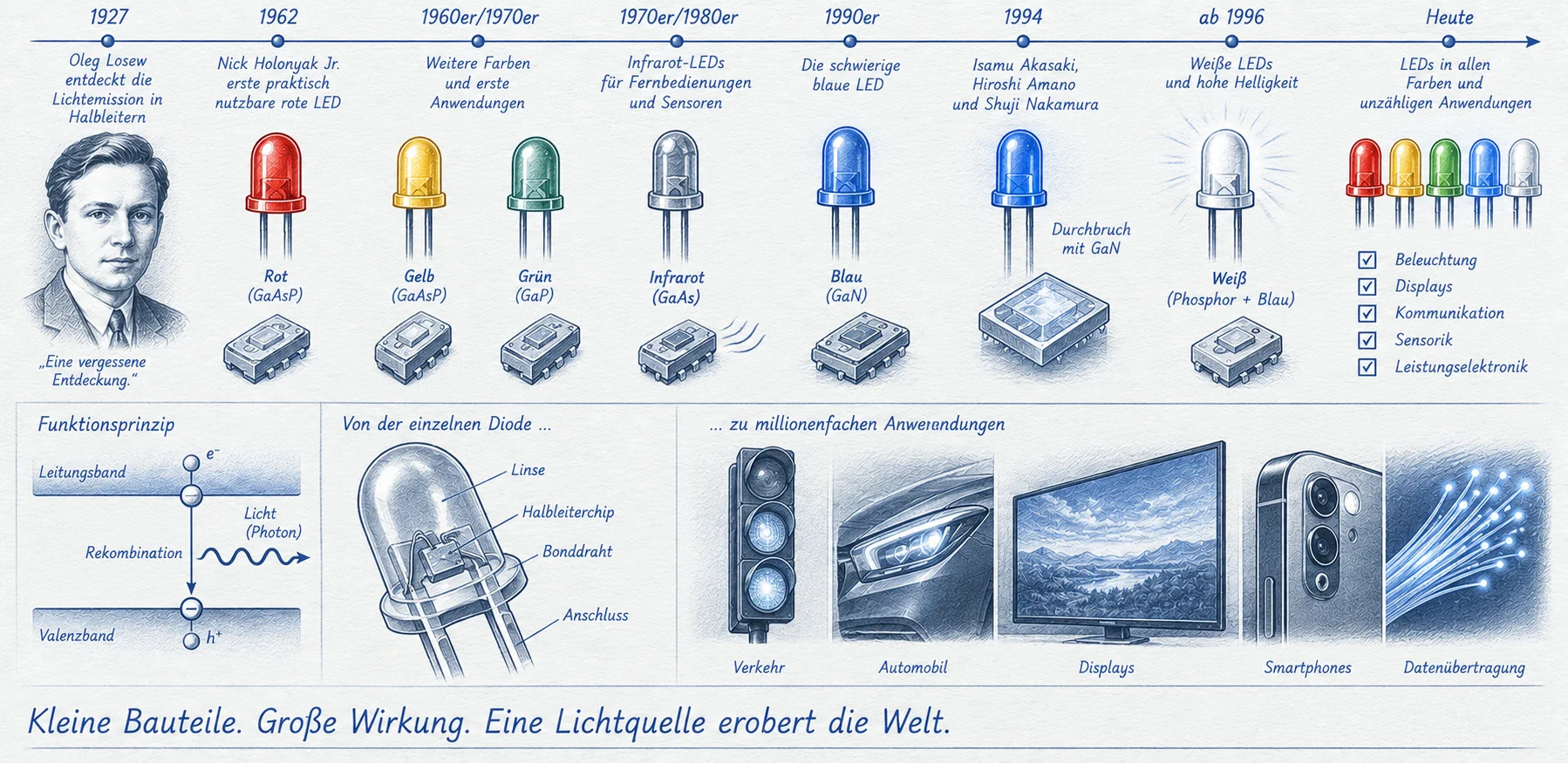
Image: ChatGPT
Before the red LED reached the market, there had already been an almost forgotten light-emitting diode. Decades before self-illuminated numerical displays or efficient lamps became practical, a Soviet radio engineer was investigating the faint glow of electrically contacted crystals. Only advances in compound semiconductors, crystal growth, and industrial manufacturing eventually turned that effect into a mass-market product. The history of the LED is therefore not a straight succession of brighter lamps: Long periods of technical difficulty separated the major discoveries.
Today, the light-emitting diode (LED) is found in status indicators, vehicle headlights, displays, sensors, and general lighting. These applications all use light generated directly in a semiconductor, but they place very different demands on materials, color, operating temperature, and packaging. The journey from barely visible electroluminescence to reliable lighting systems is also the story of modern optoelectronics.
1907–1942: A nearly forgotten discovery
In 1907, British radio engineer Henry Joseph Round published a brief observation: A silicon-carbide crystal with an electrical contact could emit light. It was an early documented description of solid-state electroluminescence, although not yet a practical lighting device. Crystal detectors were mainly used for receiving radio signals, and a faint point of light offered little immediate commercial value.
During the 1920s and 1930s, Soviet researcher Oleg Losev investigated the glow of silicon-carbide contacts in greater detail. He described the effect in scientific papers and explored optical signaling and display applications. However, controlled doping and modern epitaxial semiconductor layers did not yet exist. His experimental devices were dim and unreliable, and no industry emerged from them. Losev died in 1942 during the Siege of Leningrad. Only later did the historical significance of his work become more widely appreciated.
A common simplification needs qualification: Nick Holonyak was not the first person to make a semiconductor emit light. His achievement, decades later, was the demonstration of a practically useful visible LED based on modern compound semiconductors.
Why a semiconductor can emit light
At its core, an LED is a diode with a pn junction. Under forward bias, electrons and holes enter an active region of the semiconductor. When they recombine, the released energy can be emitted as a photon. Its energy, and therefore the wavelength of the light, depends primarily on the band structure of the material. Unlike a traditional incandescent lamp, the color does not primarily arise from the temperature of a hot filament.
Semiconductors with a direct bandgap, including gallium arsenide and many related III-V compounds, are particularly suitable. Radiative recombination is relatively probable in these materials. Silicon, by contrast, has an indirect bandgap, so radiative recombination is much less likely. Conventional silicon diodes are therefore poorly suited to efficient light emission. Ironically, silicon and germanium—the principal materials of conventional microelectronics—did not become the main materials of the LED industry.
Efficiency also depends on more than generating light inside the semiconductor. Photons may be absorbed again or trapped by total internal reflection because of the high refractive index. Efficient LEDs therefore required improvements in crystal quality as well as electrical contacts, packaging, and optical structures.
The 1950s and 1960s: From infrared to visible red
The modern history of LEDs began with progress in III-V compound semiconductors. Rubin Braunstein observed infrared emission from gallium-arsenide and related diodes at RCA in 1955. Infrared LEDs moved closer to practical use in the early 1960s, with work by James Biard and Gary Pittman at Texas Instruments marking an important step. Although invisible to the human eye, infrared light can be detected by appropriate receivers and later became valuable for remote controls, optical sensors, and short-range communication links.
In 1962, Nick Holonyak Jr. at General Electric demonstrated a practical red LED made of gallium arsenide phosphide (GaAsP). Adjusting the composition of the semiconductor made it possible to obtain visible red light. This was not a replacement for a room lamp: The output was still modest and the device was expensive. For a small signal lamp, however, it was already useful—compact, robust, and requiring no heated filament.
The pioneers also faced an industrial problem: The epitaxial structures had to grow reproducibly, and electrical contacts had to work on large numbers of devices. Only then could a laboratory result become an affordable product family.
The 1970s: Yellow, green, and the era of numerical displays
In 1972, M. George Craford, a former student of Holonyak, introduced a yellow LED and also improved the brightness of red and orange devices. Green indicators were made using materials such as nitrogen-doped gallium phosphide. The resulting LEDs were not especially bright by modern standards, but they served an important purpose in electronics: They produced specific colors directly, without color filters in front of an incandescent lamp.
As costs decreased, LEDs entered calculators, measuring instruments, digital watches, radios, and industrial controls. Seven-segment displays became particularly recognizable, using seven independently controlled illuminated segments to form numbers. Liquid-crystal displays soon proved more power-efficient for battery-operated watches because they do not need to generate their own light. For status indicators, warning lights, and readable displays in dark surroundings, LEDs remained attractive.
Early volume manufacturing was shaped less by spectacular individual devices than by process discipline. Manufacturers needed to measure luminous intensity and wavelength, sort devices into matching groups, and mount the tiny dies in packages with reliable wire bonds and transparent encapsulation. Variation between individual LEDs became an important quality-control issue.
The 1980s and 1990s: Better materials and brighter devices
The next advance came from improved epitaxial layers and new semiconductor alloys. In metal-organic chemical vapor deposition (MOCVD), precursor materials are deposited under controlled conditions onto a crystalline substrate, forming thin semiconductor layers with a specified composition. Such methods made more advanced heterostructures possible, helping to confine charge carriers and light within the active regions.
Aluminum indium gallium phosphide (AlInGaP) became especially important for high-brightness red, orange, and yellow LEDs. Moving from relatively simple structures to efficient multilayer devices significantly increased light output. These LEDs became suitable for illuminated road signs, traffic signals, and outdoor displays where early devices would have been difficult to see at a distance.
Packaging and light extraction improved too. Reflectors, transparent contact regions, and optimized chip shapes reduced optical losses. These improvements complemented the gains in electrical conversion efficiency.
The missing color: Why blue remained so difficult
High-quality white LEDs and full-color displays needed a sufficiently bright blue source, which remained elusive for decades. Blue photons have higher energy and therefore require a semiconductor with a suitably wide bandgap. Silicon carbide could produce dim blue emission, but it was not an attractive basis for highly efficient mass-market devices. Gallium nitride (GaN) offered better prospects, yet its crystal growth and p-type doping presented major challenges.
During the 1980s and early 1990s, Isamu Akasaki, Hiroshi Amano, and Shuji Nakamura achieved essential breakthroughs. Their contributions involved buffer layers to improve growth on foreign substrates, activation of p-type GaN, and the use of indium gallium nitride for the light-emitting region. Nichia introduced its first commercially successful high-brightness blue LED in 1993. The three researchers received the 2014 Nobel Prize in Physics for their achievements.
The difficult development of the blue LED is covered in greater detail in the separate historical article “Why the Blue LED Was So Difficult.” In the broader LED story, the key consequence was that bright blue and improved green LEDs enabled full-color displays and a new generation of white light sources.
From 1996 onward: A blue LED and a phosphor produce white
The most important consequence of the blue LED was the ability to produce economical white light. One approach combines separate red, green, and blue LEDs. For general lighting, however, another design became especially successful: A blue InGaN LED excites a phosphor that converts part of the blue light to longer wavelengths. The mixture of unconverted blue and converted light appears white. In 1996, Nichia introduced corresponding white LEDs using a yellow phosphor, typically cerium-doped yttrium aluminum garnet (YAG).
A simple blue-and-yellow system can offer high luminous efficacy but may reproduce certain red hues poorly. Additional phosphors can improve color rendering. The LED lamp is therefore not defined by its semiconductor die alone: The composition of the phosphor system affects color temperature, color quality, and efficiency. RGB mixing remains particularly useful wherever the colors need to change dynamically, as in stage lighting and displays.
The white LED was not a completely new kind of semiconductor diode. It was a successful combination of semiconductor emission and optical conversion, easier to scale economically than three separately controlled light sources.
From milliwatts to lighting: Why packaging became essential
An indicator lamp can operate with very little power. A streetlight or room luminaire, by contrast, must provide a substantial light output over many hours. At higher currents, heat removal becomes critical, because even an efficient LED converts part of its electrical input into heat. If the junction temperature rises too high, brightness and color change and aging accelerates.
Manufacturers therefore developed LED packages with thermally conductive supports, robust electrical connections, and suitable optical materials. Heat must travel from the die through the package into the luminaire. At the same time, photons must escape with minimal losses. Another challenge at high current density is efficiency droop: The internal efficiency of many LEDs falls as the current rises. More current does not necessarily produce proportionally more useful light.
The breakthrough of the high-power LED therefore depended on several improvements at once: better epitaxy, optimized active regions, greater light extraction, more reliable contacts, thermally effective packaging, and drivers with lower electrical losses. Only together did these make LEDs competitive with incandescent, halogen, and fluorescent lighting.
The 2000s and 2010s: LED lighting becomes an everyday product
At the beginning of the 2000s, powerful white LED lamps were still relatively expensive. As production volumes grew, wafer technology improved, and luminous efficacy increased, costs fell. Manufacturers first installed LEDs in flashlights, specialized luminaires, and architectural lighting, and later in standard lamp fittings and integrated fixtures. Driver electronics improved as well: LEDs need appropriate current regulation, unlike incandescent lamps, which can operate directly from a suitable voltage source.
Energy-efficiency requirements and government programs provided additional momentum. Beginning in 2009, the European Union gradually phased out particularly inefficient household incandescent lamps. The regulations did not simply require consumers to buy LEDs; they restricted certain inefficient lighting products. Other types of energy-saving lamps could also comply for some time.
For users, the advantages included lower electricity consumption, instant start-up, useful dimming options, and long operating life. More directional light output and lower maintenance needs made replacements attractive as well. Yet the changeover was not completed in a single step: Households, commercial buildings, and public facilities replaced their existing lamps over many years.
Efficiency, lifetime, and the limits of simple comparisons
A typical incandescent lamp produces roughly 10 to 15 lumens of visible light per watt of electrical input, fluorescent lamps can achieve substantially higher values, and modern LED products can be more efficient still. When a figure exceeds 150 or even 200 lumens per watt, however, it is essential to ask what was measured: a bare LED chip, an LED package, a complete lamp, or an installed luminaire? Drivers, optics, thermal behavior, and color quality often reduce system efficacy relative to a laboratory record.
LED lifetime is also more complicated than that of an incandescent bulb. An LED may continue operating for a long time while gradually losing brightness or changing color. The L70 metric therefore often describes the estimated time until light output falls to 70 percent of its initial value. It is not a promise that the complete product—including its power supply and other electronics—will operate without failure for precisely that period.
Decades of progress have brought new quality questions into focus: Light distribution, glare, color rendering, and flicker matter as much as raw efficiency. Good lighting is not simply the production of the maximum possible number of lumens, but the delivery of suitable light at the right place and time.
Displays, vehicles, sensors, and agriculture
Alongside room lighting, LEDs conquered numerous other markets. Traffic signals, automotive taillights, and variable road signs benefited from distinct colors, rapid switching, and low maintenance. High-power LEDs subsequently enabled advanced vehicle headlights with electronically adjustable light distributions. In LCD screens, LED backlighting gradually replaced older fluorescent tubes. Mini-LED improves local control of this backlighting, whereas Micro-LED uses large arrays of tiny, individually emissive inorganic LED elements as display pixels.
In smartphones, measuring equipment, and industrial systems, visible and infrared LEDs act as flashes, indicators, sensor illumination, or components of optical links. In controlled-environment agriculture, red, blue, and white light can be combined to suit specific growing conditions. Data communication using modulated LED light—often discussed under the term Li-Fi—is another application, although it does not generally replace established radio and fiber-optic networks.
The LED is thus not one single product but a materials and manufacturing platform serving applications with widely different technical demands.
OLED: A related but distinct development
A technology often confused with the conventional LED is the organic light-emitting diode (OLED). Here, thin layers of organic semiconductor compounds produce light instead of the inorganic III-V crystals used in most conventional LEDs. An important milestone came from Ching W. Tang and Steven Van Slyke at Kodak, who reported a practical thin-film OLED structure in 1987.
OLED display pixels emit their own light and do not require separate LCD backlighting. This enables deep blacks, thin display structures, and flexible form factors. Manufacturing methods, material degradation, and device lifetime nevertheless differ from those of inorganic LEDs. OLED therefore belongs to the broader history of electroluminescent semiconductors but should not be treated as the same technology.
From indicator lamp to global infrastructure
The development of the LED connects several industrial transformations. Without better III-V crystals, the 1907 observation could not have become a reliable light source. Without GaN and the blue LED, the transition to efficient white lighting would have taken a very different route. And without improved packages, thermal management, driver electronics, and standardized quality measurements, LEDs could not have been deployed economically in billions of luminaires.
An International Energy Agency analysis published in 2026 shows how far the transition has progressed and how much efficiency potential remains. Electricity use for indoor lighting in buildings would be substantially higher if the efficacy and market shares of older lighting technologies had remained unchanged. At the same time, older fixtures are still in service, so the transition is not complete. Repairability, replaceable components, and avoiding unnecessary electronic waste are therefore becoming more important alongside efficiency.
Within a little over a century, a faint glow at a crystal contact became one of the world's most important industrial light sources. The decisive advances were not individual inventions alone, but a long chain of semiconductor physics, materials engineering, manufacturing precision, and system design. The history of the LED is therefore also part of the history of microelectronics and modern energy supply.
Sources and further reading
- Nobel Prize in Physics 2014: Blue LEDs and White Light
- Shuji Nakamura: Biographical Account of the Blue LED Development
- S. Nakamura: Nobel Lecture, Development of Efficient InGaN Blue LEDs
- U.S. Department of Energy: LED Basics, Efficiency and Light Quality
- U.S. Department of Energy: The History of the Light Bulb
- International Energy Agency: The Next Wave of LED Lighting (2026)
- Heise: 30 Years of Blue LED – The Blue Wonder (2024)
- American Physical Society: 2014 Nobel Prize in Physics for Blue LEDs