The Battle for the Memory Chip: Japan, Korea, and the United States
October 13, 2026
Memory chips became one of the fiercest battlegrounds in the semiconductor industry. The United States led the early DRAM era, Japan overtook the market in the 1980s through manufacturing quality and scale, and South Korea later rose to dominance with Samsung and its rivals. The struggle over memory shaped industrial policy, trade conflicts, and the technological path from DRAM to NAND flash and today’s HBM for AI systems.
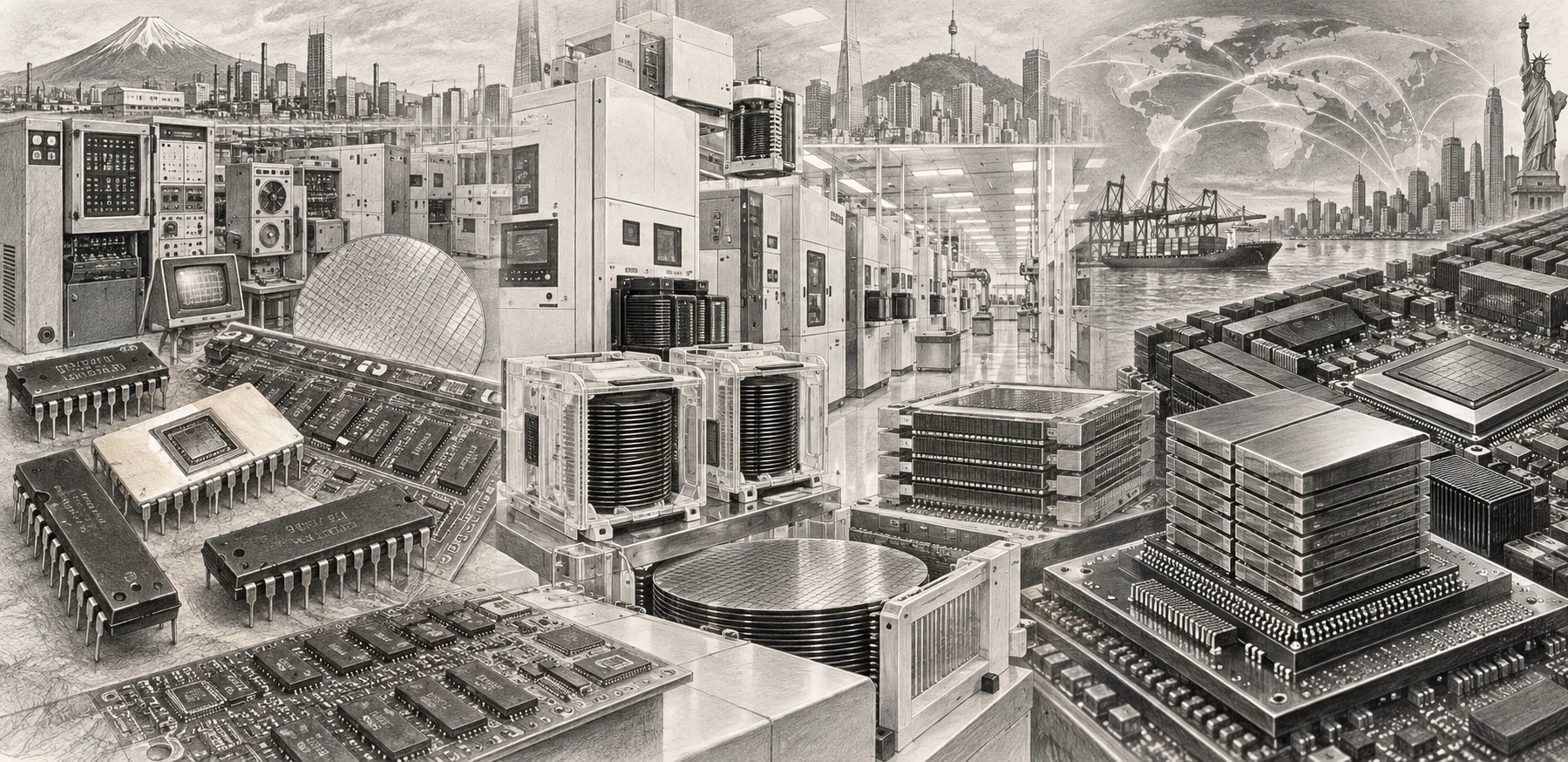
Image: ChatGPT
Few semiconductor products reveal the industrial history of the chip industry as clearly as the memory chip. Logic devices often attract the headlines because they power processors and define computing performance. Memory, by contrast, is sometimes seen as a more anonymous component—essential, but interchangeable. Yet precisely this combination of technical importance and strong price competition turned memory into one of the most fiercely contested sectors in the semiconductor business. Here, advances in design mattered, but so did yield, discipline in manufacturing, investment scale, and the ability to survive repeated price collapses.
The story begins in the United States, where semiconductor firms developed the first commercial dynamic random-access memories, or DRAMs. It continues with Japan’s rise in the late 1970s and especially the 1980s, when companies such as NEC, Toshiba, Hitachi, Fujitsu, and Mitsubishi challenged and then overtook many American competitors. In the next phase, South Korea—above all Samsung, and later Hyundai and LG—used massive investment and aggressive scaling to move from challenger to leader. By the 21st century, the center of gravity in memory had shifted again, while the product portfolio expanded from DRAM to NAND flash and, more recently, to stacked high-bandwidth memory for AI accelerators. Why did leadership change so often—and why did memory become such a geopolitical industry?
Before DRAM: magnetic cores and the search for electronic memory
Before semiconductor memory took over, computers relied heavily on magnetic-core memory. Tiny magnetizable rings threaded by wires stored bits through their magnetic orientation. Core memory was reliable and fast for its time, but it was bulky, labor-intensive, and difficult to scale economically as computing systems grew larger. Engineers therefore searched for all-electronic memory technologies that could be integrated like other semiconductor circuits.
Different approaches were explored. Static memories stored data in bistable transistor arrangements, while dynamic concepts aimed to reduce the number of components per bit. The challenge was enormous. Memory is different from many other chips because it consists of extremely large arrays of nearly identical cells. That makes density and manufacturing yield decisive. Even a clever design becomes uneconomic if it requires too many transistors or if defects ruin too much of the array.
This is what made memory such an important proving ground for the semiconductor industry. It rewarded not only invention, but also the ability to translate a regular, high-density architecture into a manufacturable and cost-effective product.
The key invention: the one-transistor DRAM cell
A decisive milestone was the development of the one-transistor DRAM cell. Its principle is elegant: each bit is stored as charge on a tiny capacitor and accessed through a single transistor. Because the capacitor leaks charge over time, the information must be periodically refreshed. This is why the memory is called dynamic. The concept made much higher density possible than more transistor-heavy alternatives and became the dominant architecture for main memory.
The roots of this architecture lie in the United States, particularly in work associated with IBM and Robert Dennard, who described the one-transistor memory cell in the late 1960s. The invention mattered not simply because it stored information. It established a path by which memory density could rise dramatically as lithography and process technology improved. Every generation could place more cells on the same chip area, reducing the cost per bit.
That cost-per-bit logic would shape the entire industry. Whoever could shrink memory cells, raise yield, and produce in high volume gained a powerful competitive advantage. In no other large semiconductor segment would manufacturing discipline prove so decisive.
Intel and the commercial birth of DRAM
In 1970, Intel introduced the 1103, widely regarded as the first commercially successful DRAM. It did not emerge into an empty field—other companies were also working on semiconductor memories—but the Intel 1103 demonstrated that DRAM could become a practical product. It offered a higher density alternative to magnetic-core memory and helped establish Intel as an important early player in semiconductor memory.
The early years were far from smooth. Reliability challenges, timing constraints, and manufacturing difficulties had to be overcome before customers fully trusted DRAM. Nevertheless, the product opened a new era. Semiconductor memory was no longer just an engineering possibility; it had become a business with enormous growth potential.
The United States led this phase. Firms such as Intel, Mostek, Motorola, Texas Instruments, National Semiconductor, and others participated in the competitive race for denser and cheaper memories. The product generations advanced rapidly: 1-kilobit DRAMs were followed by 4-kilobit, 16-kilobit, and beyond. Memory was becoming a volume industry.
Why memory became a brutal business
Memory chips differ from many specialized semiconductors because they are, to a large extent, standard products. A DRAM chip from one supplier may not be literally identical to that from another, but in broad market terms the parts are highly substitutable. Customers therefore compare price, availability, and quality very closely. Margins can shrink quickly, and leadership can change fast when one company builds more efficient factories or reaches a new density node earlier than its rivals.
In addition, memory markets are deeply cyclical. Manufacturers invest huge sums in fabrication capacity, often in expectation of future demand. If too much capacity comes online at once, prices collapse. If supply lags behind demand, prices surge. This cycle repeatedly rewarded the companies with the strongest balance sheets, the best yields, and the willingness to keep investing through downturns.
As a result, the memory industry turned into a test not only of semiconductor technology, but of industrial stamina. It was not enough to invent a chip. A successful memory company had to survive the swings of the market over many generations.
Japan rises: quality, scale, and industrial coordination
In the late 1970s and especially the 1980s, Japanese electronics companies advanced rapidly in memory. NEC, Toshiba, Hitachi, Fujitsu, Mitsubishi, and others were already significant industrial groups with broad electronics capabilities. They combined process discipline, strong manufacturing culture, and heavy investment in fabrication. At the same time, Japan’s broader industrial environment supported export-oriented technology industries and long-term industrial planning.
Japanese firms became especially powerful in DRAM. Their success cannot be reduced to a single factor. It reflected strong statistical process control, attention to manufacturing quality, close supplier relationships, and the ability to ramp large volumes effectively. In a business where yield and consistency mattered enormously, these strengths became decisive.
By the mid-1980s, Japanese companies had gained a dominant share in the DRAM market. For American firms, this was more than a normal market shift. It looked like a strategic challenge in one of the most important high-technology industries of the age.
The American response and Intel’s retreat from DRAM
The rise of Japanese competition put intense pressure on U.S. memory makers. Some American firms remained active, but many struggled against lower prices and stronger yields from Japanese rivals. One of the most symbolic turning points came in 1985, when Intel—once an early DRAM pioneer—effectively exited the DRAM business in order to focus on microprocessors.
That move was historically important because it showed that even a major technology company might find memory competition too harsh. Intel’s retreat did not mean the United States disappeared from semiconductor memory entirely, but it reflected a broader shift. American companies increasingly found stronger strategic positions in logic, microprocessors, design-intensive chips, and certain specialized memories rather than commodity DRAM.
At the same time, Micron emerged as a crucial U.S. memory player. Unlike companies that left the field, Micron chose to stay, invest, and compete directly in memory. That decision would become increasingly important in later decades.
The 1986 semiconductor trade agreement
Tensions between the United States and Japan over semiconductors led to the 1986 U.S.–Japan Semiconductor Agreement. American industry and policymakers argued that Japanese firms benefited from unfair trade practices and that foreign producers had difficulty accessing the Japanese market. The agreement aimed, among other things, to address pricing behavior and improve market access.
The accord became one of the best-known trade conflicts in semiconductor history. Yet it would be misleading to explain the entire competitive shift through the agreement alone. Japanese companies had already built substantial strength through manufacturing quality, learning, and investment. Likewise, later changes in industry leadership cannot be reduced to trade policy by itself.
Still, the agreement shows how strategic the memory business had become. DRAM was no longer just another product category. It had become a matter of national industrial concern, trade diplomacy, and technological sovereignty.
South Korea enters the battle
While the United States and Japan confronted one another, another future competitor was investing aggressively: South Korea. Companies that later became global memory leaders understood that DRAM offered a path into the core of the semiconductor industry. The sector was difficult and capital-intensive, but successful entry could deliver scale, technological learning, and global relevance.
Samsung moved particularly aggressively, investing through downturns and pursuing capacity and technology at a pace that many rivals struggled to match. Hyundai Electronics—later part of Hynix—and LG also played roles in the Korean memory expansion. Korea benefited from large industrial groups, coordinated investment strategies, and a willingness to commit to very large capital expenditures in pursuit of global leadership.
This was not an overnight success. Korean firms initially had to catch up in design, process maturity, and customer trust. But once they gained momentum, they proved able to compete generation after generation.
1992: Samsung reaches the top
A major symbolic milestone came in 1992, when Samsung became the world’s leading DRAM supplier. This was not just a company success; it marked a broader shift in the geography of memory manufacturing. The center of gravity was moving from Japan toward South Korea.
Samsung’s rise reflected several strengths: relentless capital investment, fast node transitions, high-volume manufacturing, and the ability to endure volatility. Memory is unforgiving. If a company pauses too long, it loses density leadership and cost competitiveness. Samsung showed that it was willing to sustain the investment pace required for leadership.
Once again, this transition was not caused by a single event. It emerged from the cumulative effect of technology scaling, manufacturing learning, industrial strategy, and market timing. But by the 1990s, it was clear that the memory business had entered a new Asian phase—this time centered increasingly on Korea rather than Japan.
Micron, Hynix, and the consolidation of DRAM
As the market matured, DRAM competition became increasingly concentrated. Some firms merged, some exited, and others failed during industry downturns. Micron remained the key American DRAM manufacturer. In Korea, Hyundai Electronics evolved into Hynix, which later became SK hynix. Samsung remained dominant. Japanese firms, by contrast, found it harder to sustain their earlier position in commodity memory.
This consolidation was partly the result of economics. Memory fabs became more expensive with each generation, and only a limited number of companies could justify the enormous investment needed to remain at the leading edge. The industry therefore moved toward a smaller group of very large players, each trying to maintain scale, technology leadership, and customer confidence.
By the early 21st century, DRAM had become one of the clearest examples of semiconductor concentration. The barriers to entry were so high that new challengers had little room unless supported by extraordinary capital and policy commitment.
Japan’s last big memory attempt: Elpida
Japan did not disappear from memory without resistance. One of the most important later efforts was Elpida Memory, formed through the restructuring and combination of Japanese memory operations. Elpida represented an attempt to preserve Japan’s presence in DRAM by building a more focused and internationally competitive company.
For a time, Elpida was a serious player. But the economics of the market remained punishing. Large capital requirements, intense price competition, and repeated downturns strained the company. In 2012, Elpida filed for bankruptcy protection and was later acquired by Micron.
The fall of Elpida symbolized the end of Japan’s dominant era in commodity DRAM. Japan remained highly important in semiconductor materials, equipment, and many electronic technologies—but no longer as the undisputed power in memory chips.
Beyond DRAM: the rise of flash memory
The story of the memory chip is not only the story of DRAM. Another major branch is flash memory, which stores information even when power is removed. NAND flash, in particular, became essential for digital cameras, USB storage, solid-state drives, and smartphones. Here again, Asian companies played leading roles, while American innovation and system demand remained deeply important.
Toshiba was central to the history of flash memory, building on work by Fujio Masuoka and others. Samsung also became a major force, and the competition later widened to include companies and joint ventures across Japan, Korea, and the United States. As storage demand expanded, flash memory became a strategic business in its own right, parallel to DRAM but with different product cycles and application drivers.
The rise of flash broadened the memory battlefield. Leadership in semiconductor memory now meant more than controlling DRAM. It also meant mastering non-volatile storage technologies and the manufacturing systems required to produce them at enormous scale.
3D NAND and the new capital intensity
As planar NAND scaling became more difficult, manufacturers transitioned to 3D NAND, stacking memory cells vertically to increase density. This was one of the most important architectural shifts in modern memory. Instead of relying only on lateral shrinking, companies began to build upward through many layers.
The transition increased both the technical challenge and the capital burden. Etching deep structures, controlling uniformity across many layers, and integrating complex process flows demanded advanced equipment and enormous process expertise. Once again, only the largest players could remain fully competitive.
This reinforced a pattern already familiar from DRAM: memory leadership increasingly belonged to a small number of firms with enough capital, engineering depth, and production scale to sustain repeated technology transitions.
The return of memory to the center: HBM and AI
In recent years, memory has moved back to center stage because of artificial intelligence and high-performance computing. Training and running large AI models require not only powerful processors, but also extremely fast access to data. This has made high-bandwidth memory (HBM) strategically important.
HBM is very different in packaging and system role from the early DIP-packaged DRAMs of the 1970s and 1980s. It uses stacked memory dies connected with advanced packaging technologies, often placed close to accelerators to provide very high bandwidth. In this sense, the memory battle has evolved. It is no longer only about cost per bit. It is also about bandwidth, energy efficiency, packaging, and system-level integration.
Korean firms—especially Samsung and SK hynix—have become especially prominent in HBM, while Micron also plays a major role. Once again, the memory market reveals how leadership can shift with each technological wave, yet still remain concentrated among the few companies able to master large-scale manufacturing and rapid innovation.
Why memory leadership moved from the United States to Japan and then to Korea
Looking across the decades, no single explanation is sufficient. The United States led the invention and early commercialization of DRAM because its companies were at the forefront of semiconductor innovation. Japan rose because memory rewards manufacturing excellence, process discipline, and scale, all areas in which Japanese firms became exceptionally strong in the 1980s. Korea later took over because companies there were willing to invest aggressively through cycles and build enormous production capacity while moving quickly down the technology curve.
Each transition was therefore both technological and industrial. Memory is a product where design innovation matters—but once an architecture is established, competition shifts heavily toward execution. Yield, capital access, factory utilization, cost control, and resilience during downturns become decisive. This is why memory leadership can move from one region to another more dramatically than in some design-centric semiconductor sectors.
At the same time, government policy, trade tensions, financial systems, and industrial organization always mattered in the background. The memory industry has repeatedly shown that semiconductors are never just about circuits. They are also about industrial ecosystems and national strategy.
A global industry with geopolitical weight
Today, the memory business remains global, but it is highly concentrated. A few firms dominate DRAM, and a relatively small number lead NAND. The supply chains behind them are international: materials, equipment, design tools, packaging, and end markets all cross borders. Yet the concentration of production means that memory supply has major geopolitical implications.
Memory chips now sit at the intersection of consumer electronics, cloud computing, data centers, industrial systems, smartphones, and AI infrastructure. Their strategic relevance is therefore greater than ever. A disruption in memory supply affects not only one product line, but broad segments of the digital economy.
That is why the memory chip is more than a commodity. Historically, it has been a battlefield in which technology, manufacturing, trade, finance, and national ambition repeatedly collide. From American pioneers to Japanese scale, from Korean dominance to the AI age of HBM, the battle for memory has been one of the defining struggles of semiconductor history.
Sources and further reading
- Computer History Museum: DRAM memory history
- IBM: Robert Dennard and the DRAM cell
- Intel: the story of the 1103 DRAM
- Encyclopaedia Britannica: DRAM overview
- CSIS: the global DRAM market and industry structure
- Micron: company history and memory milestones
- Encyclopaedia Britannica: Samsung Electronics
- SK hynix: company history
- Reuters: Elpida bankruptcy background
- Kioxia/Toshiba memory history
- SemiAnalysis: HBM and the AI era
- NVIDIA: why HBM matters for AI systems