Short updates from the semiconductor industry, with context and links to the relevant chapters.

November 2, 2026
Companies & Market
AI workloads are shifting memory demand beyond raw capacity and bandwidth, lifting demand for mature flash products while Macronix broadens its NOR flash, NAND and eMMC portfolio. The company is increasing 2026 capex to NT$37.8 billion, expanding 12-inch wafer capacity, and pushing higher-density, lower-power and higher-reliability nonvolatile memory for AI servers and other applications.
Read more →
·
Fundamentals
November 2, 2026
Companies & Market
BIWIN will present a broad storage portfolio at electronica 2026, ranging from 122.88 TB PCIe 5.0 enterprise SSDs to integrated embedded memory, industrial drives for continuous recording, automotive UFS and eMMC devices, and a compact removable Mini SSD. The lineup is aimed at AI infrastructure, edge computing, intelligent vehicles, embedded systems and space-constrained PCs.
Read more →
·
How Does It Work?

November 1, 2026
Artificial intelligence
Flexcompute says it is extending its Physics World Model into AI-assisted chip design, with PhotonForge 2.0, physics-verified compact models and automatic Verilog-A export. The company is targeting photonic chips, optical I/O, co-packaged optics and advanced packaging problems such as warpage, thermal effects and signal integrity.
Read more →
·
How it Works
November 1, 2026
Companies & Market
Infinitesima is commercializing angstrom-scale process control for semiconductor manufacturing with a hybrid optical/AFM platform that measures chip structures directly in three dimensions. The company says its Metron3D system is already being deployed in production and is aimed at tighter process control for advanced packaging, hybrid bonding, High-NA EUV resist work and post-etch metrology.
Read more →
·
Metrology
November 1, 2026
Research
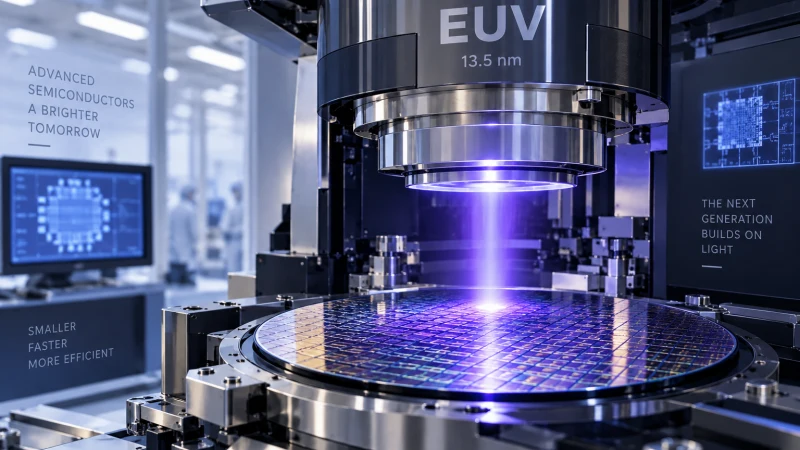
Intel is already using High-NA EUV on selected layers in a subset of Panther Lake processors, Samsung has outlined a DRAM rollout for 2028, and TSMC plans advanced-node volume adoption from 2030. The technology still faces smaller exposure fields, stitching constraints and tough economics, but recent production milestones suggest its deployment curve is only delayed, not derailed.
Read more →
·
Photolithography
October 30, 2026
Companies & Market
Imec spin-off Noak has secured €5 million from the Helios Foundation, Nuhma and V2HFin to scale perovskite-silicon tandem PV and move the technology toward European manufacturing. The company is building on imec and UHasselt IP, long-term outdoor testing data and a cell architecture aimed at higher efficiency, lower metal use and easier recycling.
Read more →
·
How It Works

October 30, 2026
Research
AI is already becoming effective in semiconductor design, where models, rules, constraints, and solver outputs define a structured environment. Manufacturing is harder because it has to manage the physical reality of as-built geometry, process drift, material variation, and measurement evidence across the package and process flow.
Read more →
·
Advanced Packaging
October 30, 2026
Manufacturing & Processes
AI is reshaping semiconductor factories as much as the systems they produce. Intel Foundry says scaling AI now depends not only on smaller transistors, but also on power delivery, connectivity, advanced packaging and supply chain resilience, while AI is also being used to improve quality and shorten yield learning in manufacturing.
Read more →
·
How does it work?

October 30, 2026
Industry & People
HBM and DRAM supply remains tight across the industry, while advanced packaging capacity is being pushed harder by AI demand. At the same time, foundries, equipment makers and AI infrastructure suppliers are expanding investments, pricing, and partnerships to keep pace with next-generation compute and memory ramps.
Read more →
·
Advanced Packaging
October 29, 2026
Devices & Products
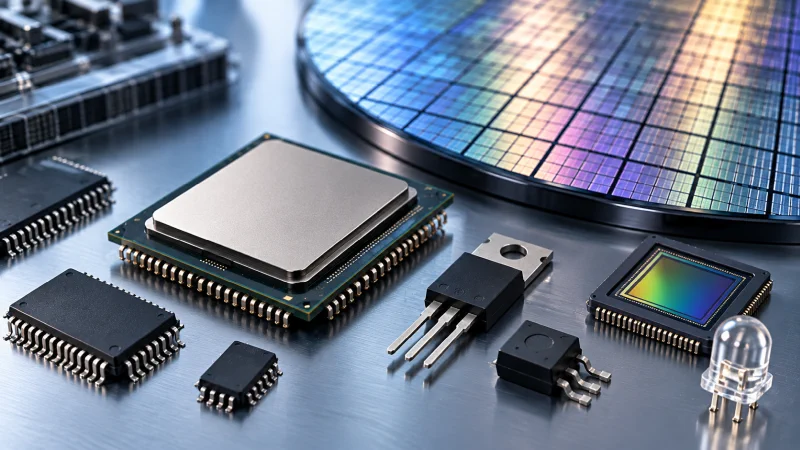
Programmable mixed-signal ICs can replace bulky RC timing networks and firmware-dependent startup logic with deterministic multi-rail sequencing. GreenPAK devices combine counters, lookup tables, comparators, state machines, and GPIO routing to control regulator enables, qualify power-good signals, verify rail thresholds, latch faults, and manage orderly shutdown without relying on processor firmware.
Read more →
·
Fundamentals
October 29, 2026
Companies & Market
Samsung Electronics reported third-quarter revenue of 195.3 trillion won and operating profit of 107.4 trillion won, driven by strong demand for AI memory chips. The semiconductor division delivered most of the earnings, while the mobile business remained under pressure from higher component costs and weak margins.
Read more →
·
Fundamentals
October 29, 2026
Design & EDA
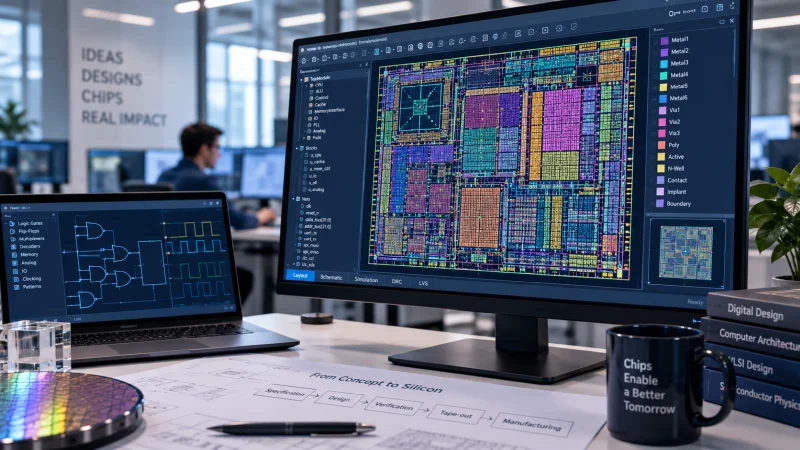
As semiconductor designs grow larger and regressions produce more simultaneous failures, debugging is turning into an orchestration problem. An AI-native workflow combines intelligent binning, witness simulation reruns, autonomous root cause analysis, and verification to reduce the number of failures that need separate investigation and to spend compute only where it is most useful.
Read more →
·
How It Works
October 29, 2026
Companies & Market
At its OktoberTech event, Infineon tied together three shifts in semiconductor demand: more AI processing at the edge, a slower but ongoing move toward software-defined vehicles, and the push from 800 VDC sidecars toward future 1 MW rack power architectures. The company also pointed to its Dresden fab as new manufacturing capacity for power and analog/mixed-signal devices.
Read more →
·
How It Works
October 29, 2026
Research
AI agents and digital twins are pushing design decisions earlier in the chip flow, but verification, trust in surrogate models, and multi-physics complexity remain major limits. Several experts argue that the next phase of shift left will be less about freezing specifications early and more about refining architectures and implementation choices as new information appears.
Read more →
·
How does it work?
October 29, 2026
Companies & Market
Vinci says it has closed a $250 million Series B at a $1.5 billion valuation and is expanding its physics analysis platform for semiconductor engineering. The company wants to make thermal, thermo-mechanical and convective fluid analysis available while designs are still changing, so engineers can assess placement, power and packaging choices before decisions become costly to reverse.
Read more →
·
How does it work?