IBMInternational Business MachinesIBM is a US technology company active in computer hardware, software and semiconductor research., AMD and the Quantum Science Center at Oak Ridge National Laboratory have unveiled a new hybrid quantum/classical platform focused on quantum error correction, one of the main technical hurdles on the path to useful fault-tolerant quantum computers. The collaboration is tied to the U.S. Department of Energy’s Quantum Genesis Mission and is intended to help researchers identify which combinations of qubits, classical resources and workflows scale best.
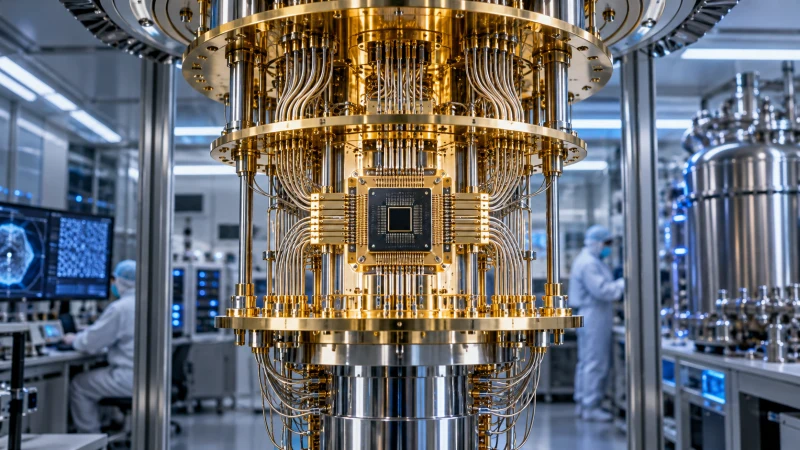
The Oak Ridge setup places IBMInternational Business MachinesIBM is a US technology company active in computer hardware, software and semiconductor research.’s quantum hardware, including the 120-qubit IBMInternational Business MachinesIBM is a US technology company active in computer hardware, software and semiconductor research. Quantum Nighthawk processor, alongside ORNLOak Ridge National LaboratoryORNL is the U.S. national laboratory hosting the co-located system.’s Umbra HPC1. High Performance ComputingCompute applications with particularly high performance demands, cited here as a driver for packaging and testing.2. high-performance computingHPC denotes compute-intensive chips that require advanced testing support. system. Umbra uses AMD Instinct MI355X GPUgraphics processing unitA GPU is a parallel graphics processor widely used for AI acceleration.s and 5th Gen AMD EPYCEPYCEPYC is AMD’s CPU family used in the Umbra HPC system. CPUcentral processing unitMain processor that executes program instructions and performs data operations.s, giving the project a classical computing base for decoding optimization, software orchestration and other error-correction tasks.
IBMInternational Business MachinesIBM is a US technology company active in computer hardware, software and semiconductor research. and AMD are framing the platform as a co-design environment for quantum error correction, where researchers can compare different techniques in terms of qubit count, runtime, sampling requirements and classical support. IBMInternational Business MachinesIBM is a US technology company active in computer hardware, software and semiconductor research. says its hardware can measure qubits during computation, act on those results in real time, tune protection signals precisely and expose raw measurement data for analysis.
The work is linked to the Quantum Genesis Mission target of 100 logical qubits running 100,000 hard operations by late 2028. IBMInternational Business MachinesIBM is a US technology company active in computer hardware, software and semiconductor research. says it has already demonstrated experiments reaching 70 logical qubits and 438 hard operations, leaving a large gap to close if the DOE1. design of experiments2. Department of EnergyThe DOE is the U.S. government department backing the Quantum Genesis Mission. goal is to be met. Based on those figures, the hard-operation count would need to rise by roughly 230 times.
In the description of the effort, hard operations refer to the resource-intensive non-Clifford class of quantum operations. Those operations are more expensive to implement in fault-tolerant systems and can demand extra error-correction overhead, although the exact cost depends on the code used on a given platform.
The platform extends existing work between IBMInternational Business MachinesIBM is a US technology company active in computer hardware, software and semiconductor research., AMD and ORNLOak Ridge National LaboratoryORNL is the U.S. national laboratory hosting the co-located system.. Earlier this year, IBMInternational Business MachinesIBM is a US technology company active in computer hardware, software and semiconductor research. and ORNLOak Ridge National LaboratoryORNL is the U.S. national laboratory hosting the co-located system. used quantum and classical workloads to simulate magnetic materials and calculate molecular configurations related to fusion-fuel production. IBMInternational Business MachinesIBM is a US technology company active in computer hardware, software and semiconductor research. also said it has used AMD GPUgraphics processing unitA GPU is a parallel graphics processor widely used for AI acceleration.s in sample-based quantum diagonalization workflows and that the two companies previously demonstrated an error-decoding algorithm running on AMD chips.
The effort is also positioned as part of IBMInternational Business MachinesIBM is a US technology company active in computer hardware, software and semiconductor research.’s broader quantum-centric supercomputing strategy and may feed into its Quantum Starling system, which IBMInternational Business MachinesIBM is a US technology company active in computer hardware, software and semiconductor research. describes as its first fault-tolerant quantum computer.
More broadly, the project reflects a push to integrate quantum processors with HPC1. High Performance ComputingCompute applications with particularly high performance demands, cited here as a driver for packaging and testing.2. high-performance computingHPC denotes compute-intensive chips that require advanced testing support. and AIartificial intelligence resources so that error correction can move from laboratory demonstrations toward scalable systems for scientific applications.