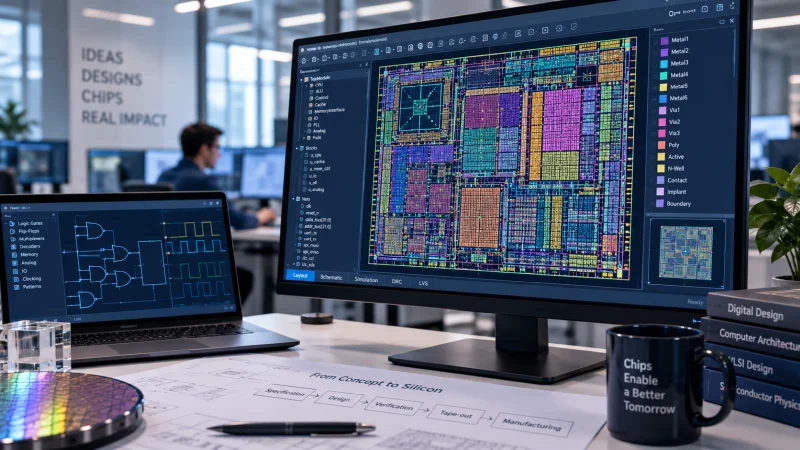
AIartificial intelligenceAI stands for artificial intelligence is starting to change how chip teams approach derivative designs, but the technology is not yet able to replace the engineering judgment needed to turn a previous design into a new, viable product. The central problem is that an AIartificial intelligenceAI stands for artificial intelligence-generated derivative can look promising in simulation or in the tool flow, while still failing on manufacturability, cost, traceability, or physical feasibility.
One major limitation is data availability. The information needed to reuse a design safely is often incomplete because important details sit outside the design team, including at foundries, OSAT1. Outsourced Semiconductor Assembly and TestA business model in which assembly and test services are provided by a specialized external supplier.2. outsourced assembly and testAn OSAT provider assembles, packages, and tests chips for other companies.s, and equipment or process providers. At the same time, established EDA1. electronic design automationSoftware tools for designing, simulating, verifying and laying out electronic circuits.2. equipment data acquisitionSystem or method for collecting, storing, exchanging or analyzing data. flows must absorb rapidly changing AIartificial intelligenceAI stands for artificial intelligence capabilities without losing predictability or silicon-proven results.
AIartificial intelligenceAI stands for artificial intelligence can still be useful in specific parts of the flow. It can inspect existing architectures and RTL1. resistor-transistor logicSemiconductor device or transistor technology used to control electrical currents and signals.2. register transfer levelRTL is the hardware description layer where design assumptions are often captured.3. Register-Transfer LevelRTL describes the hardware implementation stage targeted by the benchmark., identify bottlenecks, suggest design modifications, optimize EDA1. electronic design automationSoftware tools for designing, simulating, verifying and laying out electronic circuits.2. equipment data acquisitionSystem or method for collecting, storing, exchanging or analyzing data. settings, and automate parts of verification and debugging. It can also orchestrate workflows across multiple tools, reducing the manual effort needed to adapt IP1. image placement2. Internet protocolInterface or communications concept for transmitting data between devices and systems.3. Intellectual PropertyIP denotes licensable semiconductor design blocks or technology elements.4. intellectual property blockAn intellectual property block is a reusable predesigned unit for semiconductor or system designs. to new specifications. But the resulting design is not automatically ready for tape-out.
A recurring issue is that AIartificial intelligenceAI stands for artificial intelligence may produce changes that are far more radical than an incremental update. One example discussed involved a low-pass filter, described as a pixelated model with a high-frequency section around 2 GHzgigahertzGigahertz is a frequency unit equal to 10^9 hertz.. Changing that target to 2.5 GHzgigahertzGigahertz is a frequency unit equal to 10^9 hertz. could lead an AIartificial intelligenceAI stands for artificial intelligence system to generate a completely different structure instead of a familiar, human-recognizable adaptation. The result may function, but it can still raise questions about manufacturability, cost, and whether the new structure preserves useful design intuition.
Reusing hardware across chip generations has long been a way to amortize non-recurring engineering costs and shorten development time, but that reuse is still much harder than software reuse. Software can often be adapted across related products more easily, while hardware IP1. image placement2. Internet protocolInterface or communications concept for transmitting data between devices and systems.3. Intellectual PropertyIP denotes licensable semiconductor design blocks or technology elements.4. intellectual property blockAn intellectual property block is a reusable predesigned unit for semiconductor or system designs. scaling and SoCsystem-on-chipAn integrated circuit that combines major system functions on a single chip. integration still demand substantial manual work. Different products can share building blocks, yet their requirements for camera count, speed, power, and system integration can diverge sharply.
The same pressure shows up in EDA1. electronic design automationSoftware tools for designing, simulating, verifying and laying out electronic circuits.2. equipment data acquisitionSystem or method for collecting, storing, exchanging or analyzing data. tool usage. Teams may spend months iterating on tool recipes without changing RTL1. resistor-transistor logicSemiconductor device or transistor technology used to control electrical currents and signals.2. register transfer levelRTL is the hardware description layer where design assumptions are often captured.3. Register-Transfer LevelRTL describes the hardware implementation stage targeted by the benchmark. or floorplan, which becomes an expensive source of inefficiency. AIartificial intelligenceAI stands for artificial intelligence-aided fine-tuning exists, but it can consume significant compute, and further innovation is still needed to reduce that overhead.
A deeper obstacle is that no current tool fully optimizes timing, IR1. infraredInfrared metrology can characterize silicon structures because silicon transmits light at certain infrared wavelengths.2. current times resistanceIR denotes the voltage drop produced when current flows through an electrical resistance.3. internal resistanceIR drop is the voltage drop across the ohmic resistance of a conduction or supply path.4. integrity riskIntegrity risk refers to the risk that electrical or physical conditions impair a design's function.5. integrated voltage dropIR describes voltage drop in a chip's or board's power delivery network., and thermal effects together at the RTL1. resistor-transistor logicSemiconductor device or transistor technology used to control electrical currents and signals.2. register transfer levelRTL is the hardware description layer where design assumptions are often captured.3. Register-Transfer LevelRTL describes the hardware implementation stage targeted by the benchmark. or architecture level. Some flows can help from the netlist stage onward, but early-stage abstraction remains difficult because thermal analysis depends on layout layers and IR1. infraredInfrared metrology can characterize silicon structures because silicon transmits light at certain infrared wavelengths.2. current times resistanceIR denotes the voltage drop produced when current flows through an electrical resistance.3. internal resistanceIR drop is the voltage drop across the ohmic resistance of a conduction or supply path.4. integrity riskIntegrity risk refers to the risk that electrical or physical conditions impair a design's function.5. integrated voltage dropIR describes voltage drop in a chip's or board's power delivery network. depends on the placement of power sources. That leaves end-to-end automation limited, especially when physical effects across die, package, board, and enclosure interact in ways that traditional chip-centric flows do not capture.
Verification remains a bottleneck even when existing IP1. image placement2. Internet protocolInterface or communications concept for transmitting data between devices and systems.3. Intellectual PropertyIP denotes licensable semiconductor design blocks or technology elements.4. intellectual property blockAn intellectual property block is a reusable predesigned unit for semiconductor or system designs. blocks have already been proven. Reused blocks can behave differently depending on their surrounding circuitry and physical environment, so known-good components still need careful revalidation in new contexts. The overall direction is clear: AIartificial intelligenceAI stands for artificial intelligence can accelerate derivative design, but a reusable chip flow still depends on complete design knowledge, physics-aware tools, and verification methods that match the complexity of the final implementation.