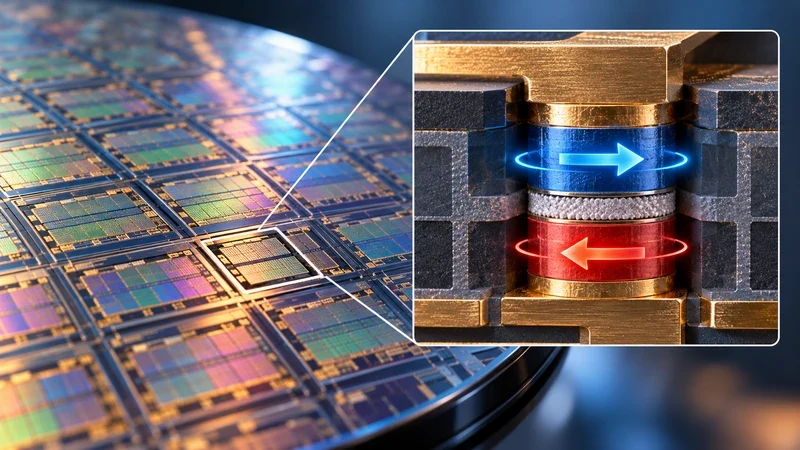
Everspin Technologies is trying to move magnetoresistive random-access memory, or MRAM, from established industrial niches into AIartificial intelligence servers, data centers and satellite systems. The company is targeting workloads that need fast persistent memory and is presenting MRAM as an alternative where NOR flash has become harder to source.
President and CEOchief executive officerCEO identifies the company’s top executive who made the statement. Sanjeev Aggarwal said customers are evaluating MRAM for performance and reliability, but also because some NOR flash parts are unavailable. He said the price gap between MRAM and NOR flash has narrowed as NOR flash prices rose under supply constraints. Everspin sees a multi-billion-dollar opportunity if MRAM can capture part of that displaced demand.
The company is also working on supply diversification. Everspin currently makes toggle MRAM in Chandler, Arizona, and has an initial 10-year foundry services agreement with Microchip Technology for an additional 8-inch MRAM and tunnelling magnetoresistance sensor line in Gresham, Oregon. For STT-MRAM, Everspin has worked with GlobalFoundries on 12-inch wafers since 2016 and plans to tape out a product on TSMCTaiwan Semiconductor Manufacturing CompanyTSMC is named as a founding partner of the EPIC Center.’s 16-nm process.
At the Storage Networking Industry Association Developer Conference, Everspin showed MRAM modules combined with a Compute Express Link controller to create a pool of persistent memory accessible through CXLCompute Express LinkA high-speed interface standard used here to pool memory across servers and GPUs..mem. Aggarwal described the concept as a memory tier between DRAM1. dynamic random access memoryMemory technology or system for temporarily or permanently storing digital information.2. dynamic random-access memoryDRAM is a volatile memory technology and NANDNot ANDA logic gate that outputs 0 when all inputs are 1, and outputs 1 in all other cases flash, with access times in the 20 to 30 nanosecond range. The intended use includes AIartificial intelligence data such as key-value caches, checkpoints and intermediate data waiting to be written to storage.
Capacity remains a constraint. Everspin’s current densities reach 1 Gb, while the company is considering stacked devices at 8 Gb or 16 Gb. Aggarwal argued that such capacities would still be sufficient for temporary data handling, especially when MRAM is used to reduce the gap between working memory and storage rather than replace NANDNot ANDA logic gate that outputs 0 when all inputs are 1, and outputs 1 in all other cases flash outright.
In the satellite segment, Astro Digital selected Everspin’s 64-Mb PERSYST STT-MRAM as fail-safe boot memory for a Raven satellite bus in a geosynchronous Earth orbit mission. Everspin says the memory’s radiation tolerance, write speed and reliability are advantages in space applications, while the surrounding silicon may still need backup protection if it is exposed to radiation damage.
Everspin is also evaluating AIartificial intelligence-server use cases with MaxLinear under a memorandum of understanding that covers metadata management, log data, write buffering, cache and other data-intensive workloads. The company says the effort is aimed at technical validation and market development rather than an immediate product launch or volume commitment.
Beyond these projects, Everspin reported 2025 revenue of $55.2 million and said it intends to build on demand from data centers, aerospace and defense, low-Earth-orbit satellites and industrial automation. The company’s broader roadmap includes higher-density parts and newer interfaces, including a planned 4-Gb DDR6 device.