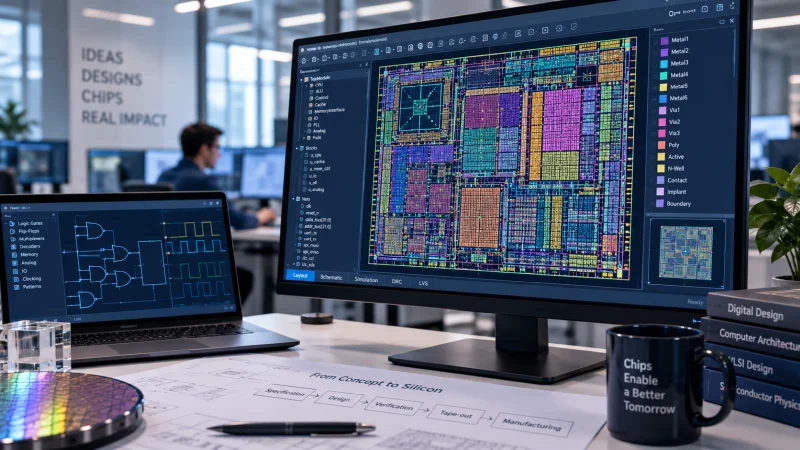
Hardware-assisted verification is no longer reserved for the largest SoC programs. According to the source, falling costs and more capable FPGAfield-programmable gate arrayReconfigurable logic device whose internal circuits can be programmed after manufacturing.-based prototyping systems are making this approach practical for medium-complexity designs as well, at a point where full hardware/software co-verification has become essential for schedule and quality.
The core problem is not only whether the silicon functionally works, but whether the SoC and the application software behave correctly together. Traditional flows split software into hardware-independent and hardware-dependent parts, then rely on stubs, simulation, or emulation while RTL1. resistor-transistor logicSemiconductor device or transistor technology used to control electrical currents and signals.2. register transfer levelRTL is the hardware description layer where design assumptions are often captured.3. Register-Transfer LevelRTL describes the hardware implementation stage targeted by the benchmark. is still evolving. That method breaks down when code dependencies are hidden deep in the application stack, or when speed and capacity are too limited to run the full software stack realistically.
FPGAfield-programmable gate arrayReconfigurable logic device whose internal circuits can be programmed after manufacturing.-based prototyping addresses that bottleneck by programming the SoC model onto the prototype hardware so software teams can execute the stack against a realistic representation of logic and memory. This makes it possible to expose hardware/software interactions earlier, while both RTL1. resistor-transistor logicSemiconductor device or transistor technology used to control electrical currents and signals.2. register transfer levelRTL is the hardware description layer where design assumptions are often captured.3. Register-Transfer LevelRTL describes the hardware implementation stage targeted by the benchmark. and software are still changing, instead of waiting for first silicon.
The article also stresses that synthetic test patterns are a poor substitute for real operational behavior. For systems such as ADAS, networking, or storage, the relevant data streams are unpredictable and can only be judged properly with live traffic and real peripheral behavior. In principle, the prototype should run close to full speed while connected to cameras, sensors, actuators, displays, or network links.
To make that practical, interface handling becomes critical. Implementing critical interfaces directly inside the prototype can consume design resources and may not match ASICapplication-specific integrated circuitIntegrated circuit customized for a specific task timing, while external adapter cards add power, clocking, signal-integrity, and mechanical complexity. The example given is Siemens EDA1. electronic design automationSoftware tools for designing, simulating, verifying and laying out electronic circuits.2. equipment data acquisitionSystem or method for collecting, storing, exchanging or analyzing data.’s Veloce proFPGA CS platform with extension boards for Ethernet, PCIePeripheral Component Interconnect ExpressPCIe is the high-speed serial interconnect standard Gen4, USB, DDR4, Flash, and multiple connector options. These cards plug directly into the FPGAfield-programmable gate arrayReconfigurable logic device whose internal circuits can be programmed after manufacturing. boards to reduce latency and simplify bring-up, so the prototype can be connected to the real operating environment at or near full speed.