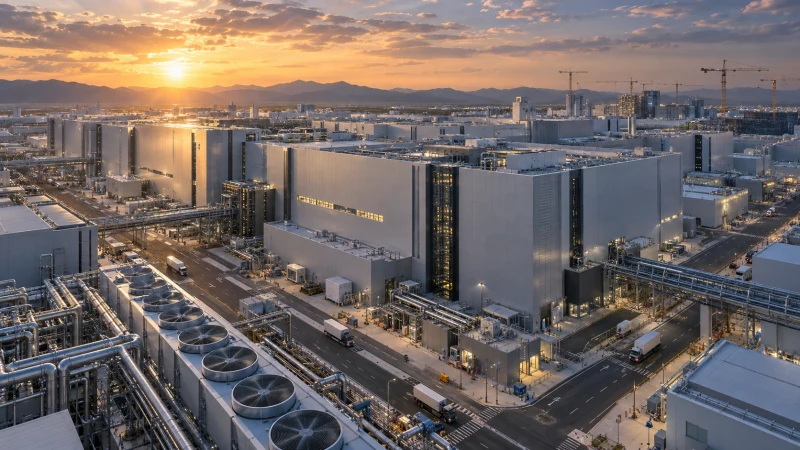
GlobalFoundries has opened an Advanced Facilities Control Centre (AFCC) in Singapore as the first deployment of a new AIartificial intelligence-enabled facilities operations model for its global manufacturing footprint. The centre was developed with Siemens and is intended to make facilities management more data-driven, more automated and more resilient across GF’s sites.
At the Singapore campus, five fab-specific control centres will be merged into a single command centre in the first phase. The AFCC combines facilities data with operational metrics and adds advanced monitoring and visualisation functions, together with AIartificial intelligence-driven capabilities such as predictive maintenance.
The stated operational goal is to help teams resolve issues faster, identify root causes more quickly, detect emerging problems earlier and focus on the highest-impact actions. GF also plans to use the platform for benchmarking operational metrics across sites once the system is fully rolled out globally.
GlobalFoundries said the full deployment could integrate more than 1 million critical data points from facilities equipment across its manufacturing network. The company expects 24/7 equipment health monitoring to reduce unplanned downtime and shorten response times. A centralised model is also meant to improve the use of space, equipment and workforce resources while reducing duplicated infrastructure, energy consumption and associated emissions.
Autonomous robots are part of the setup as well. Equipped with thermal imaging, gas detection, vibration acoustics and other anomaly-sensing functions, they carry out routine patrols and inspections on the fab floor and campus, sending real-time data to the AFCC for analysis and response.
Singapore serves as the starting point for the rollout, which GlobalFoundries ties to its digital manufacturing strategy. The company says the new command centre will also change the role of facilities engineers by shifting more of their work toward higher-value diagnostics and problem-solving.
In parallel, the company and its local partners point to Singapore as a base for further digital manufacturing work, including advanced packaging and silicon photonics.