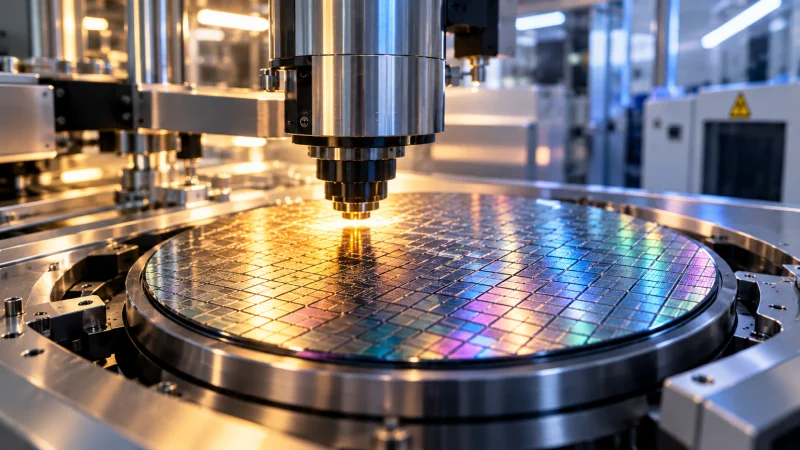
onsemi has unveiled the Embedded Power Platform (EPP), a wafer-level packaging concept that turns the silicon substrate into an active part of the power architecture rather than a passive housing. The approach is aimed at systems that need more power in less space, especially AIartificial intelligence infrastructure and electrified vehicles.
At the core of EPP is a highly integrated wafer-level structure in which heterogeneous dies are embedded in silicon and interconnected through redistribution layers. The platform is designed to bring silicon, silicon carbide (SiCsilicon carbideSiC is one of the power semiconductor materials being assigned a distinct role in the power delivery chain.), and gallium nitride (GaNgallium nitrideGaN is another material platform mentioned for use in different power delivery roles.) into one common architecture, with electrical, mechanical, and thermal optimization performed together from the start.
onsemi says this replaces the traditional sequential workflow, where package, power electronics, and thermal design are treated separately and can force late-stage compromises. EPP is intended to support co-design, co-simulation, and co-optimization across different applications and power levels, while allowing devices such as FETfield-effect transistorTransistor whose conduction channel is controlled by an electric field.s, drivers, and controllers to be placed in a single package.
The company reports that, in a solid-state circuit-breaker design, an EPP-based solution was about 50% smaller and 20% cooler than existing designs. onsemi also claims the architecture can deliver 3–5x higher power density than current solutions, which would directly address the size and heat constraints that limit rack-level compute density and compact power electronics.
Subaru is working with onsemi as an early engagement partner to evaluate the platform for future electrified vehicle architectures. onsemi says sampling is expected to begin in 2026 with strategic customers and ecosystem participants across automotive and AIartificial intelligence applications.