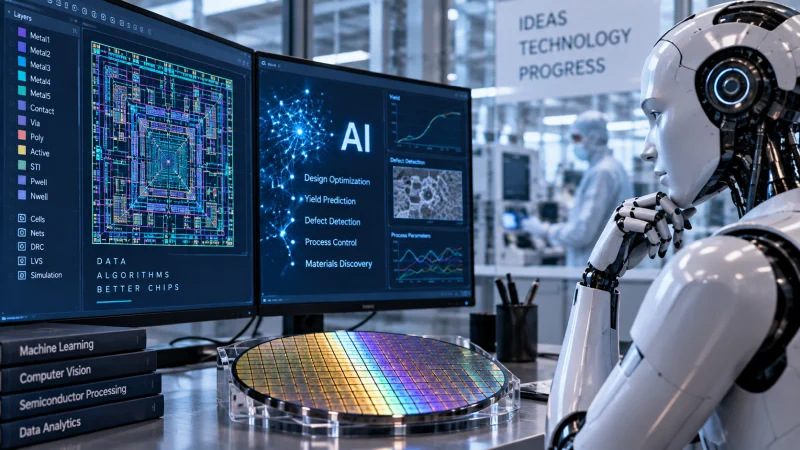
Engineering teams are facing a shift in how design decisions are made. As high-speed interfaces, dense PCBprinted circuit boardBoard that mechanically supports components and electrically interconnects them with copper traces. layouts, advanced packaging, and tighter performance targets increase complexity, traditional workflows based on simulation, manual review, and revalidation are struggling to keep up. The article argues that a more intelligent engineering process is emerging, built on three linked capabilities: optimization, automation, and AIartificial intelligence.
Optimization is presented as the first step away from intuition-led design. Instead of testing only a few configurations, teams can sweep hundreds or thousands of alternatives and see how each affects objectives such as insertion loss, impedance, power delivery, or routing feasibility. The point is not just to find a working design, but to identify tradeoffs and solution regions that would be difficult to uncover through experience alone.
Automation addresses a different bottleneck: execution. Modern projects require repeated analysis across revisions, operating conditions, and manufacturing tolerances. The source notes that the limiting factor is often engineering time rather than compute capacity. By embedding repeatable procedures into workflows, automation reduces manual setup, improves consistency, and makes best practices less dependent on individual specialists.
AIartificial intelligence is positioned as the layer that helps teams interpret the growing volume of results. A single design can generate many reports, metrics, and compliance outputs, creating information overload instead of data scarcity. The article highlights root-cause analysis as a particularly difficult task, since degraded eye patterns or other failures may stem from loss, discontinuities, crosstalk, power delivery, or connector transitions. AIartificial intelligence can help surface the most likely contributors faster.
As a concrete example, the dBRICK design shows the kind of structure that stresses these methods: multiple PCIePeripheral Component Interconnect ExpressPCIe is the high-speed serial interconnect standard Gen3 channels, high-density FPGAfield-programmable gate arrayReconfigurable logic device whose internal circuits can be programmed after manufacturing. interfaces, differential routing, vias, breakout regions, and several power delivery networks. The text also points to Siemens EDA1. electronic design automationSoftware tools for designing, simulating, verifying and laying out electronic circuits.2. equipment data acquisitionSystem or method for collecting, storing, exchanging or analyzing data.’s HyperLynx as an environment where swept-parameter analysis, power delivery network optimization, guided compliance flows, scripting, and emerging AIartificial intelligence features are being combined. The overall direction is clear: engineering workflows are moving from isolated analyses toward connected systems that use optimization, automation, and AIartificial intelligence together.