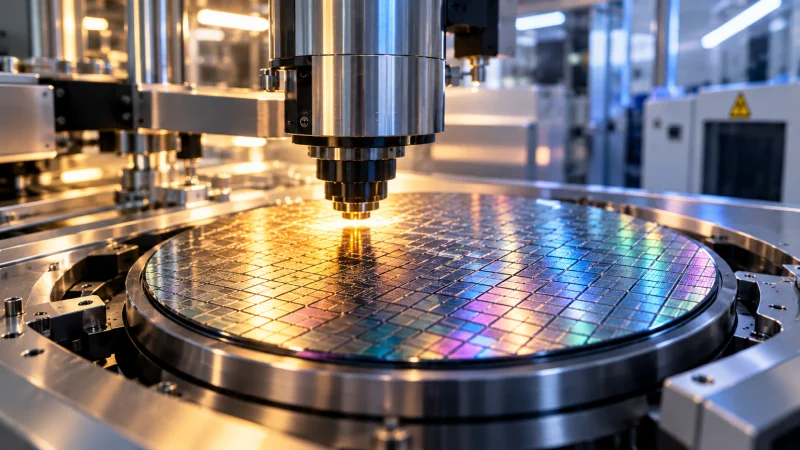
Stacked-die and multi-chip architectures are now central to performance scaling as monolithic designs become harder and more expensive to advance. Chiplets, advanced packaging, and 3D integration are enabling higher performance, higher bandwidth, and tighter functional integration for AIartificial intelligence and HPC1. High Performance ComputingCompute applications with particularly high performance demands, cited here as a driver for packaging and testing.2. high-performance computingHPC denotes compute-intensive chips that require advanced testing support. systems, but they also expose a growing power-delivery problem inside the package.
As more compute resources are added, current density rises sharply and the number of independent voltage domains increases. That combination places heavy demands on shared power-delivery resources and makes voltage droop more likely when AIartificial intelligence workloads swing quickly between load states. To compensate, designers often add guard bands and operating margins, but those measures can reduce the efficiency and performance that the silicon could otherwise reach.
Routing congestion is another consequence. More compute tiles, memory interfaces, and die-to-die links increase both signal density and power-delivery complexity, which in turn raises resistance and tightens voltage margins. The result is a stronger tradeoff between scaling through integration and maintaining stable power delivery across the package.
Intel Foundry is addressing this by moving voltage regulation closer to the load. Its approach centers on integrated voltage regulators, or IVRIntegrated Voltage RegulatorA regulator integrated close to the load to improve power delivery and transient response.s, which allow higher-voltage power distribution while reducing current density in the package, increasing regulation bandwidth, and lowering dependence on large decoupling capacitor networks.
One path is FIVRFully Integrated Voltage RegulatorA voltage regulator architecture that moves the last conversion stage onto the processor., which moves the final voltage-conversion stage onto the processor itself. Intel’s CoaxMIL magnetic inductor technology is intended to support higher current density than earlier approaches while using less area, improving conversion efficiency and response to workload transients for AIartificial intelligence and HPC1. High Performance ComputingCompute applications with particularly high performance demands, cited here as a driver for packaging and testing.2. high-performance computingHPC denotes compute-intensive chips that require advanced testing support. devices.
A second path is C2VRContinuous Capacitive Voltage RegulatorA voltage-regulation approach that uses capacitive technology instead of traditional inductors., a continuous capacitive voltage regulator that replaces traditional inductors with high-density capacitor technology. By integrating capacitors directly on the voltage-regulator chiplet, C2VRContinuous Capacitive Voltage RegulatorA voltage-regulation approach that uses capacitive technology instead of traditional inductors. targets high efficiency, very high current density, and fast response to bursty current demand, with the goal of reducing voltage droop in accelerator workloads.
Intel Foundry also describes IVRIntegrated Voltage RegulatorA regulator integrated close to the load to improve power delivery and transient response. chiplet architectures that place voltage conversion closer to the compute die than conventional motherboard regulators. Depending on the package, regulation can be placed on the landside, embedded within package layers, or beneath compute dies, opening the way for vertical power-delivery schemes and shorter distribution distances in stacked-die systems.
As AIartificial intelligence systems continue to evolve, power delivery is becoming as important to scaling as transistor and packaging innovation. The direction is clear: future data-center platforms will need tighter voltage control, higher efficiency at extreme current densities, and more responsive conversion close to the load.